
The fastest path to local visibility is a combination, not a single tactic: a fully completed Google Business Profile, a set of targeted service area pages linked directly from that profile, and a steady flow of genuine customer reviews with clean, consistent citations. Together these three signals tell Google exactly who you serve, where, and whether real customers trust you, which is what moves a listing into the local pack.
TL;DR:
- Set service areas by city or ZIP code, hide your address without a storefront, and link the profile directly to the matching city page.
- Write each service area page with distinct neighborhood details, local services, useful FAQs, and price ranges; noindex cities you cannot cover with original content.
- Start with five to ten cities surfaced by search data, then weigh job history, practical driving distance, and competitor strength before expanding.
- Request honest reviews after each job, never offer incentives or gate feedback, and answer every review specifically; FTC rules prohibit fake or incentivized reviews.
Table of Contents
- Google Business Profile essentials for service businesses
- Service area pages: why they matter and where they fit in your site
- How to structure high-quality service area pages
- On-page and technical SEO for service area pages
- Citations, reviews, and reputation management
- How to choose which cities and pages to prioritize
- Measurement, quick wins, and ongoing operations
- How a done-for-you content program handles this for you
- Leveraging localized social media signals to enhance local SEO
- Competitor analysis and local market research for service area targeting
- Author perspective: balancing SAP scale and quality
- Grow your service area pages without adding to your plate
- FAQ
- Sources
Google Business Profile essentials for service businesses
Most service businesses leave money on the table inside their own Google Business Profile before they ever touch a webpage. Start with the primary category since it carries more ranking weight than secondary categories, then fill out every applicable service under the services section with short, specific descriptions rather than generic labels like “plumbing.”
If you work from a van or a home office rather than a storefront, mark the listing as a service-area business and hide your address. This keeps your profile accurate and avoids the mixed signals that confuse both customers and Google’s ranking systems.
- Set your service areas by city or zip code rather than accepting an overly broad default radius, since Google’s own guidance warns that stretching the list too far can mis-center your business marker and hurt accuracy.
- Add a direct phone number with click-to-call enabled, and keep hours current, including holiday adjustments.
- Upload fresh photos of completed jobs, your team, and your vehicles on a regular basis rather than a one-time batch.
- Use booking or appointment links where your workflow supports them, so a search click becomes a scheduled job with no extra steps.
The single biggest upgrade most businesses skip: linking specific GBP fields, like the website URL or the “Services” call-to-action, to the exact service area page that matches the query, instead of dumping every click on the homepage. A deeper guide on profile maintenance walks through the fields worth revisiting every quarter.
Check GBP Insights regularly. The search terms report shows you which city and service combinations people are already typing to find you, which is the cheapest market research available and should directly inform which service area pages you build next.
Pro Tip: Swap your GBP website link from your homepage to your best-matching service area page this week. It costs nothing and often lifts click-through within days.
Service area pages: why they matter and where they fit in your site
A service area page (SAP) is a page built for a city or region you serve, even though you have no physical office there. That distinction matters because a location page describes a real address people can walk into, while an SAP describes the geography you drive to.

For a mobile plumber, electrician, or roofing crew, SAPs are often the only realistic way to rank for city-specific searches. Search Engine Land’s guide to service area pages notes that SAPs let service-area businesses earn organic rankings for city-specific queries even when they lack storefronts, which is exactly the gap a van-based business needs to fill.
Google’s quality systems do not reward a page just because it mentions a city name. They reward pages that are genuinely useful: specific enough that a reader in that city feels the content was written for them, not copy-pasted from a template with the city swapped out.
- SAPs capture “near me” and “[service] in [city]” searches that a single homepage can never rank for across dozens of towns.
- Usefulness and uniqueness are the quality bar Google applies, so each page needs its own local detail, not a find-and-replace city name.
- A well-built SAP converts better than a generic page because it answers the local version of the question: can you actually come to my neighborhood.
How to structure high-quality service area pages
A good SAP follows a repeatable template, but the content inside each block has to change city by city or the page collapses into the thin, duplicate content Google quietly deprioritizes.
- URL and title: Use a clean pattern like
/service-areas/city-service/and write a unique title tag and H1 for every page, something closer to “Emergency Drain Cleaning in Riverside” than a generic “Our Services.” - Local summary block: Open with two or three sentences naming the city, nearby neighborhoods, and the specific problems you handle there.
- Service offerings with local texture: List what you do in that area, referencing details locals recognize, like older housing stock, common soil conditions, or typical permit requirements.
- FAQ block: Answer the three or four questions that city’s customers actually ask, which also gives you a natural spot for schema markup.
- Pricing or cost ranges: Publishing even a rough range answers “how much is [service] in [city]” searches directly, and Search Engine Land’s analysis of localized SERPs points to cost data on SAPs as a strong driver of both rankings and conversions for exactly these queries.
- Contact and booking CTA: Place click-to-call, a booking widget, and a visible service-area map near the bottom.
Add trust elements where you have them: a short local case study, a before-and-after photo set, or a line naming a nearby landmark or neighborhood your crew just finished a job in. These small, specific details are what separate a page Google treats as original from one it treats as a duplicate with a different city name pasted in.
The most common failure mode is building fifty city pages from one template and changing only the H1. Thin, duplicate-feeling SAPs rarely rank and can drag down the pages around them. A practical SAP structure guide covers additional block variations if you want to see more layout options before you start building.
Pro Tip: Write the first SAP by hand, get it ranking, then use it as the real template, not a hypothetical one, for every city page that follows.
On-page and technical SEO for service area pages
Structured data gives Google a shortcut to understanding what your SAP is about instead of guessing from prose. At minimum, mark up each page with LocalBusiness schema including your service name, the areaServed value for that city, telephone, and priceRange where you publish one.
- Add
serviceandareaServedproperties so the schema matches the city named in your title and content, not a generic service list. - Use canonical tags carefully: each SAP should canonicalize to itself, never to a single “master” services page, or you tell Google to ignore the very pages you built.
- Include every SAP in your XML sitemap and in a crawlable HTML index page or navigation menu, since a store-locator widget built entirely in JavaScript can be invisible to crawlers.
- Never block SAP directories in robots.txt by accident. It happens more often than you would expect when a staging configuration gets pushed live.
- If a city page genuinely cannot support unique content yet, noindex it rather than publishing thin filler that drags down the cluster’s overall quality signal.
- Check mobile page speed and tap-target sizing on the click-to-call button specifically, since that is the single most common conversion action on a service business page.
The Search Engine Land SAP guide also recommends linking GBP directly to the most relevant SAP and keeping a clear HTML path to every page so search engines can discover them without depending solely on a widget.
Citations, reviews, and reputation management
Consistent NAP data, your business name, address, and phone number, across directories like your GBP, Yelp, and industry-specific listings reduces the conflicting signals that make Google hesitant to trust a listing. Audit your top ten citation sources at least twice a year and correct mismatches as soon as you find them.
Reviews carry real weight, but how you collect them matters legally as well as strategically. The FTC’s final rule on fake reviews prohibits buying or selling fake consumer reviews and allows civil penalties for knowing violators, which means incentivized reviews, review gating, and undisclosed employee reviews are all territory to avoid.
- Ask every customer for a review right after the job, while the experience is still fresh, rather than relying on occasional campaigns.
- Never offer a discount or gift in exchange for a positive review, and disclose any material connection if a reviewer has one to your business.
- Respond to every review, positive or negative, with a specific, constructive reply rather than a copy-pasted thank-you.
- Feature a few genuine testimonials on the matching SAP, since local proof next to local content reinforces the same trust signal twice.
One compliance fact worth keeping in writing: the FTC’s rule specifically targets fake and incentivized reviews, so building a review process around honest requests protects both your rankings and your business from penalty exposure.
How to choose which cities and pages to prioritize
Building SAPs for every city within a hundred miles sounds thorough but wastes time on towns that never search for you. A short, data-driven selection process gets you building the right pages first.
- Pull your GBP Insights search queries and your Search Console data to see which cities already generate impressions or calls.
- Cross-reference that list with your actual job history: which towns do you already serve profitably and repeatedly.
- Check competitor density in each city. A town with three established competitors already ranking is a harder lift than a nearby town with none.
- Favor cities within a realistic driving radius, matching the same practical-distance thinking Google recommends for setting service areas rather than a radius that looks good on paper but is impossible to service same-day.
- Prioritize high-intent patterns first, searches that pair a service with a city name or the word “cost,” since those visitors are closer to booking than someone searching a broad informational term.
- Start with your top five to ten cities, get those pages ranking and converting, then expand the cluster.
Once the first batch is live, group related SAPs into a cluster linked back to your core service pages, so link equity and relevance flow in both directions instead of each page sitting in isolation.
Measurement, quick wins, and ongoing operations
Local SEO results show up in a specific set of numbers, and tracking the wrong ones hides real progress. Watch local pack impressions and search queries in GBP Insights, direction requests, phone calls, website clicks, and booking completions where you offer online scheduling.
- Fix inconsistent phone numbers across your site and directories first, since that single error can silently break call tracking and citation trust at once.
- Add a booking widget or a more visible click-to-call button to your top three SAPs and compare completion rates before and after.
- Publish a rough price range on pages that currently lack one, since cost queries are high-intent and easy to win.
- Test small changes one at a time, a CTA button’s wording, a new hero photo, a shorter booking form, and give each test a few weeks before judging it.
Set a quarterly rhythm: audit citations, refresh photos, check for broken booking links, and revisit which cities deserve a new SAP based on the latest search query data. A 12-step local SEO checklist is a useful recurring reference for that quarterly pass.
How a done-for-you content program handles this for you
Building and maintaining a full SAP cluster, keeping citations clean, and publishing fresh local content every month is a real operational load on top of running the actual service business. That is the gap a managed program like ours is built to close.
Through MySearchHero, subscribers receive a monthly bundle: published SEO articles, authority backlinks from our publisher network, Reddit brand mentions in relevant conversations, and AI-generated social media posts, all delivered on autopilot rather than requiring a content calendar you have to manage yourself.
- Early visibility signals, like new indexed pages and fresh backlinks, typically appear within the first few weeks.
- Compounding gains in rankings and organic traffic build over months as the content and link footprint grows.
- A broader growth playbook shows how these deliverables fit together for a service business specifically.
The honest decision point is time versus cost: DIY gives you full control but demands hours each week you could spend on jobs, while a managed program trades a flat monthly fee for that time back.
Pro Tip: If your team cannot commit at least a few consistent hours a week to content and citation upkeep, a managed program is likely cheaper than the opportunity cost of doing it piecemeal.
Leveraging localized social media signals to enhance local SEO
Social profiles will not directly boost your Google rankings the way a backlink or a citation does, but they do reinforce the same consistency signals Google already checks elsewhere. A Facebook or Instagram business page with your current address, phone number, and service area listed the same way as your GBP adds another consistent data point across the web.
Localized posts, a finished job in a specific neighborhood, a customer shoutout, a seasonal reminder tied to local weather or events, keep your profiles active and give you content to link back to your matching service area page. That link, even a casual one in a post caption, sends a small but real signal of relevance between your social presence and the geography you claim to serve.
Engagement also matters indirectly: a profile customers actually comment on and share tends to get surfaced more in local community groups and recommendation threads, which drives the kind of branded search activity that correlates with stronger local visibility. Geotagging posts to the city you just worked in, and tagging the neighborhood or venue when appropriate, reinforces the same local story your SAPs and GBP already tell.
Keep the cadence realistic. A handful of genuinely local, photo-backed posts each month beats a generic stream of stock content that never mentions a real city or job.
Competitor analysis and local market research for service area targeting
Before building a new SAP, spend twenty minutes studying who already ranks for that city and service combination. Search the exact query you are targeting and note which competitors appear in both the local pack and the organic results below it.
Open a top competitor’s service area page and check what it actually covers: do they publish pricing, do they list specific neighborhoods, do they have reviews visible on the page itself. A competitor with a thin, generic page is an opening. A competitor with detailed local content, visible reviews, and clear pricing sets the bar you need to clear.
Check their citation footprint and review count on their GBP listing as a rough proxy for how established they are in that market. A newer or inconsistent profile is often easier to outrank even in a city with heavier search volume.
Use this same research to decide page order. Cities where the top three results are weak are faster wins than cities dominated by a well-optimized regional competitor, even if the second city has more raw search volume.

Author perspective: balancing SAP scale and quality
My honest read after watching this pattern repeat across service businesses: ten genuinely useful service area pages beat sixty thin ones every time. Google’s quality systems are good at spotting a template with the city swapped, and a cluster of weak pages can quietly suppress the strong ones sitting next to them.
For a small team, that means building slower but building real. Write the local detail by hand for your first few cities, confirm they rank and convert, then decide whether a managed program makes sense for scaling the rest without your time disappearing into it.
— Mike
Grow your service area pages without adding to your plate
We built a managed content program to handle exactly the workload this guide describes, delivering a monthly bundle of published articles, backlinks, Reddit mentions, and social posts, scaled to different growth levels.
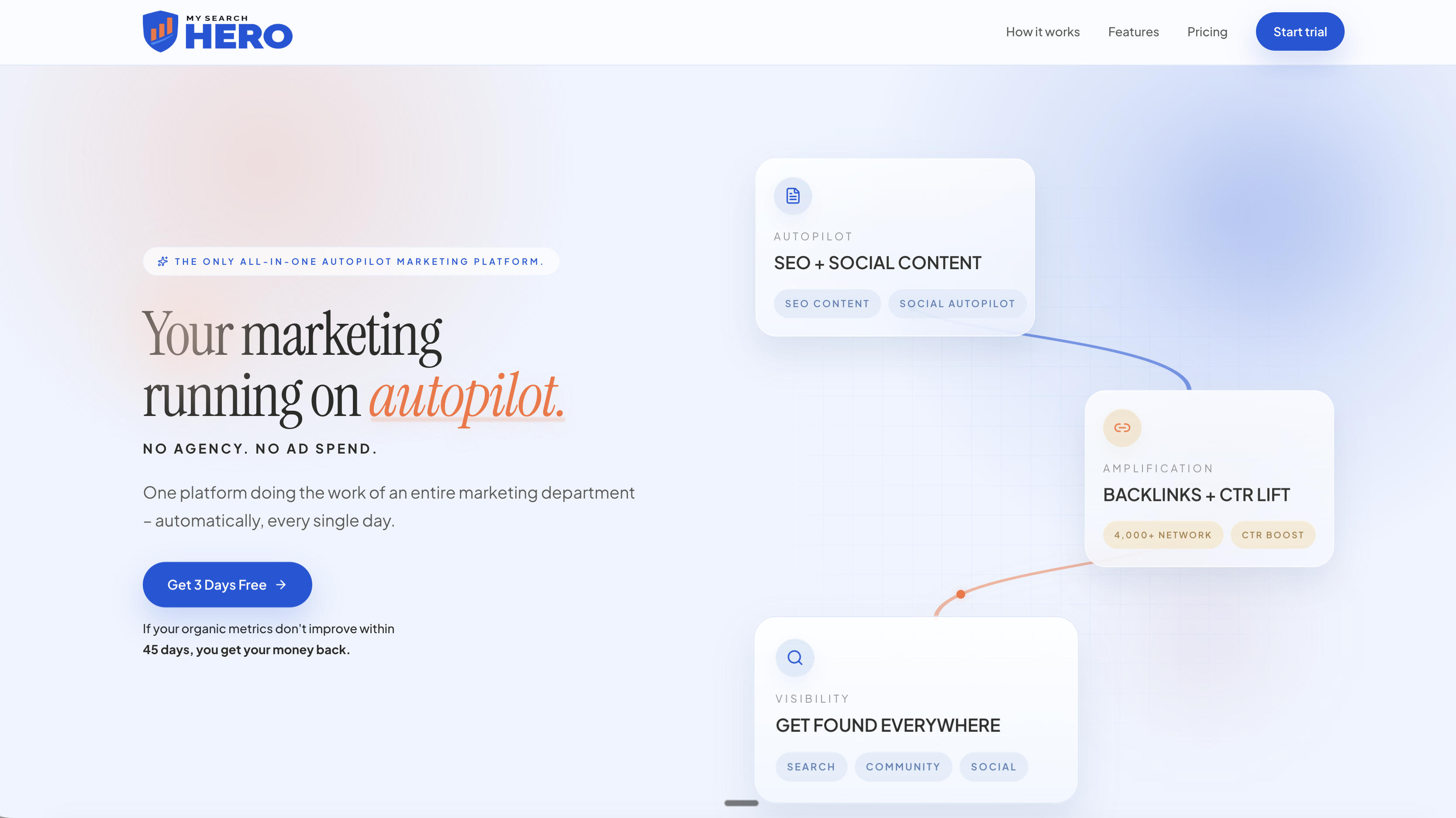
If building and maintaining a full SAP cluster sounds like more time than you have, see which MySearchHero plan fits your business and get your content pipeline running on autopilot.
FAQ
How much do local SEO services cost?
Pricing varies widely by provider and scope, from a few hundred dollars a month for basic management to several thousand for full-service programs. Our own plans run from $197 to 2997 USD per month depending on the bundle of deliverables, viewable in full on the MySearchHero plans page.
Is SEO dead now with AI?
No. Search engines still rank pages using the same core signals, relevance, trust, and usefulness, and AI-generated search summaries draw their answers from indexed, well-optimized content rather than replacing it. If anything, a complete Google Business Profile and well-built service area pages matter more, since they give both traditional search and AI answer engines clear information to cite.
What is the 80/20 rule in SEO?
A common SEO approach generally involves focusing most of your effort on the small set of pages, keywords, or fixes that drive the majority of your results, rather than spreading equal effort across everything. For a service business, that often means prioritizing your Google Business Profile and your top five to ten city pages before building out a long tail of lower-demand locations.
Is doing local SEO worth it for a small business?
Yes, for most service businesses it is one of the more reliable ways to generate calls and bookings without ongoing ad spend. A complete Google Business Profile combined with targeted service area pages and genuine reviews consistently outperforms a generic, unoptimized web presence in local search results.
Sources
- Service Area Pages: Boost Local SEO Across Locations
- Federal Trade Commission Announces Final Rule Banning Fake Reviews and Testimonials
- Google Business Profile: Service area business guidance