
The biggest benefit of AI in marketing is that it lets a small team do work that used to need several people: drafting content, scheduling posts, sorting customer data and reporting on results. The U.S. Small Business Administration (SBA) says AI can help small businesses do more with less by saving time and cost and supporting competitiveness. The benefit is real. It only shows up when a person still checks the facts, the prices and the promises. This guide covers where AI pays off for a local service business, where it backfires, and what Google says about AI content.
TL;DR
- AI saves the most time on repetitive marketing work: first drafts, social posts, review replies, resizing messages and reporting.
- Larger companies report real gains. In BCG’s survey, 91% of CMOs saw a positive efficiency impact, though that is a survey of marketing leaders, not a guarantee for your shop.
- Google does not ban AI content. It penalizes scaled, unoriginal pages made to manipulate rankings, whoever or whatever wrote them.
- The risks are inaccurate content, privacy exposure and overconfidence. A human should approve everything customers see.
- Start small, measure calls, leads and bookings, and keep what moves those numbers.
Table of Contents
- The main benefits of AI in marketing
- What AI can do for a local service business
- The risks nobody should skip
- AI and SEO: separating myths from Google’s guidance
- Our perspective: AI is a delivery system, not a strategy
- Where MySearchHero fits
- How to judge whether AI marketing is working
- Frequently asked questions
- Sources
The main benefits of AI in marketing
Most rankings for this topic list the same handful of advantages. Here they are, translated into what they mean for a plumber, a dentist, a landscaper or a law office.
1. Time and cost savings
This is the benefit that matters most when you are the owner, the technician and the marketing department at once. The SBA’s guide points to efficiency, time savings and lower costs as the core small business gains. A blog post that took three hours to outline and draft can reach a solid first draft in minutes. You then spend your time on the part only you can do: adding local facts and approving the result.
2. Handling repetitive work
The SBA lists practical uses that map to a typical week: drafting blog posts, generating and scheduling social posts, adapting one piece of content into several variations, and drafting replies to online reviews. None of these is glamorous. All of them are tasks that get skipped when the schedule is full, which is why consistency is the hidden benefit. A steady posting rhythm beats a burst of activity every few months.
3. Producing and adapting content
One original idea can become a website article, a short social post, an email and a few ad variations. BCG’s 2023 research found that among organizations using generative AI in marketing, 49% pursued content creation as an application. For a local business, the practical version is simple: write or record one real customer story, then let AI help reshape it for each channel.

4. Better targeting and segmentation
AI can sort customers by behavior, find patterns in who books and who does not, and suggest which message fits which group. In the same BCG survey, 41% pursued market segmentation. For a local service business the plain-language use is this: separate emergency callers from planned-maintenance customers, and stop sending them the same offer.
5. Personalization
Personalization was the top application in BCG’s survey, pursued by 67% of respondents. At small scale it can be modest and still useful: a follow-up email that mentions the service the customer actually bought, or an offer timed to the season when they last called.
6. Faster measurement and decisions
IBM describes AI marketing systems that can analyze campaign effects in near real time, recommend actions and help direct spend. You do not need enterprise software to benefit. A dashboard that connects a published article or post to the calls and form fills that followed tells you what to repeat and what to drop.
7. Productivity gains, with caveats
BCG reports that 93% of surveyed CMOs saw a positive or very positive effect on work organization and 91% saw one on efficiency, and its early observations pointed to productivity gains as high as 30%. Treat these as signals, not forecasts. They come from marketing leaders at larger organizations in 2023, not from a three-person HVAC company.
What AI can do for a local service business
The SBA recommends starting small and testing value rather than buying everything at once. A sensible first month looks like this:
- Pick one bottleneck. Maybe it is review replies, maybe it is the blog that has not been updated since spring.
- Use AI for the first draft only. Give it your real services, service area, hours and pricing rules, so it is not guessing.
- Add what only you know. Neighborhood names, job photos, the odd problem you solved last week.
- Approve before publishing. Check every price, guarantee and claim.
- Track results. Calls, leads, bookings, cost per lead and hours saved, the measures the SBA suggests watching.
If you want a deeper look at content specifically, our small business guide to AI in content goes through the workflow step by step, and our piece on AI in local SEO covers visibility in local results.
Tasks you can automate, and tasks you should not
| Task | Automate? | What a person still checks |
|---|---|---|
| First drafts of articles and posts | Yes | Facts, local details, tone |
| Resizing one message for several channels | Yes | Brand voice, links |
| Social post scheduling | Yes | Timing, anything time-sensitive |
| Review reply drafts | Yes, as drafts | Accuracy, empathy, anything about a dispute |
| Routine customer questions and call routing | Yes | Edge cases, complaints |
| Reporting and data sorting | Yes | Whether the numbers make sense |
| Prices, guarantees, legal or medical claims | No | Everything, every time |
| Targeting decisions and sensitive customer data | Partly | Privacy, fairness, who sees what |
The split follows the SBA’s guidance: people keep oversight of accuracy, prices, promises, tone, sensitive data and every high-stakes or customer-facing output.
The risks nobody should skip
The pages that rank for this topic tend to treat risks as a short paragraph at the end. For a small business they deserve more weight, because one wrong promise on your website costs you more than it costs a big brand.
The SBA names the main ones: hallucinated or inaccurate content, privacy and security exposure, intellectual-property problems, biased outcomes, customer distrust and unsupported performance claims. Its advice is practical: limit sensitive inputs, test narrowly, fact-check and review outputs, document a simple policy, and back up any claim about results. It also recommends having another person review outputs from free tools and considering legal advice where appropriate. If you handle regulated information, for example patient or client records, talk to your attorney or compliance adviser before pasting anything into an AI tool.
A cautionary study on overconfidence
A 2025 field study of more than 300,000 private mental-health practices found that demand rose on average after practices used ChatGPT to rewrite their descriptions, but fell for inexperienced owners. The authors tie that drop to sharply raised prices after adoption, consistent with owners overestimating the quality of AI-generated text. Prices later reversed after demand fell. The lesson is not that AI copy fails. It is that AI polish can make weak positioning look stronger than it is. Test the message with real customers before you change prices on the strength of it.
AI and SEO: separating myths from Google’s guidance
This is where most small business owners are misinformed, in both directions. Some believe Google automatically punishes AI writing. Others believe AI can mass-produce rankings. Neither is right.
Myth: Google bans AI-generated content. Google’s February 2023 guidance says that appropriate use of automation is fine when it is not used primarily to manipulate rankings. Its current guidance adds that generative AI can help research and structure original content, but outputs may contain hallucinations and must be fact-checked before publication, including metadata and structured data.
Myth: Publish a hundred AI pages and rankings follow. Google’s spam policy defines scaled content abuse to include generating many pages with generative AI without adding value for users, and says violating sites may rank lower or disappear from Search. The deciding issue is intent and value, not who typed the words.
Myth: You need special AI files or formatting. Google’s guide to generative AI features says there is no special requirement for llms.txt, special markup, tiny content chunks or exact keyword variations, that Search ignores llms.txt for rankings, and that there is no ideal page length. Foundational SEO practices and useful, original, reliable content still carry the weight.
For a local business, that means AI is a drafting aid, not a replacement for substance. A page about water heater replacement in your city should include your real process, your real service area and photos from real jobs. If you want to go further into how search is changing, see our practical notes on AI Overviews and SEO and on how to measure AI search visibility.

Our perspective: AI is a delivery system, not a strategy
We build MySearchHero for local and service-based business owners, so we see the same pattern often. Owners do not fail at marketing because they lack ideas. They fail because the work never gets finished. The article is half-written, the social account goes quiet for six weeks, and nobody asked a satisfied customer to mention the business anywhere online.
That is why we think the value of AI is consistency. SEO compounds: articles, backlinks, brand mentions and social activity each add a little, and they add up when they happen every month rather than in occasional bursts. Automation is what makes the rhythm possible without hiring an agency or adding to your own workload.
But we are also firm about the limits. AI does not know your service area, your pricing rules or your best customer story unless someone tells it. Content that adds nothing new is exactly what Google’s spam policy targets. So the right model is automation that is grounded in your actual business, measured against real outcomes such as organic traffic, calls and leads, and not judged by how much content it produces.
If you remember one thing: ask any AI marketing tool, ours included, how it connects activity to results. If the answer is volume, keep looking.
— Mike
Where MySearchHero fits
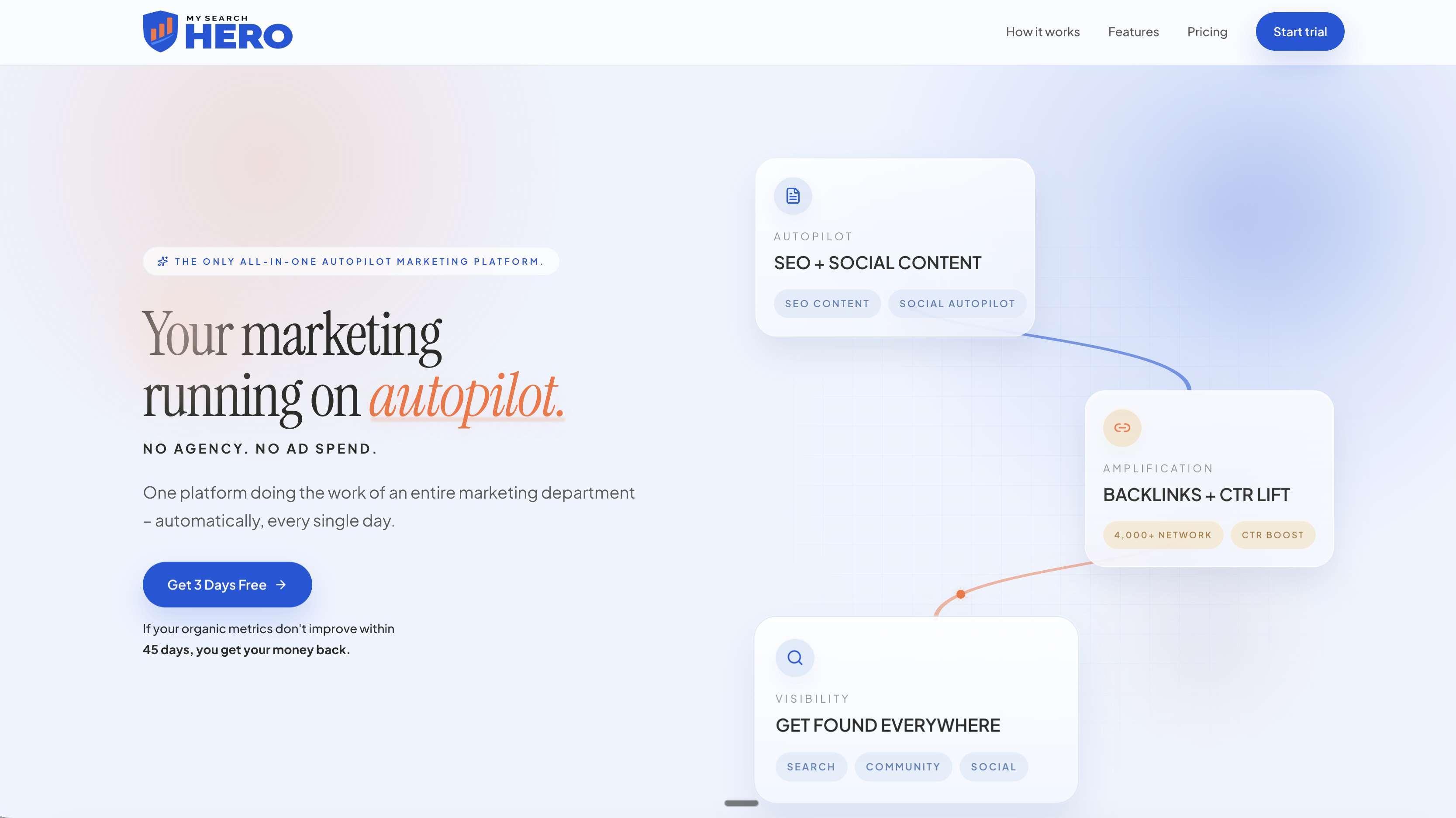
If you want the benefits above without managing a stack of tools or providers, that is what we built. MySearchHero is a done-for-you subscription that delivers each month a bundle of AI-generated SEO articles published to your website, backlinks through a publisher network, Reddit brand mentions in relevant conversations, and AI-generated social posts across platforms, with CTR signal boosting and reporting included.
Plans start at $197 per month for Spark, $297 for Authority and $397 for Hero, with Enterprise at $2,997 per month. Annual billing is $1,970 for Spark, $2,970 for Authority and $3,970 for Hero. Hero combines SEO, backlinks, CTR boosting, Reddit presence and automated social posting in one plan, and we back it with a 45-day money-back guarantee if your organic metrics do not improve.
You can compare the tiers and start on the MySearchHero pricing page. If you would rather read first, our marketing archive and our social media posting guide for small businesses are good next steps.
How to judge whether AI marketing is working
Benefits only count if they show up in the business. Set a baseline before you start, then check monthly.
- Time saved. Hours per week you no longer spend on drafting, posting and reporting.
- Leads. Calls, form submissions and booked jobs that can be traced to organic search, social or referrals.
- Cost per lead. Total marketing spend divided by leads, compared with what you paid before.
- Visibility. Organic traffic, rankings for your service and city terms, and how often your business appears in AI-driven answers.
- Quality. Complaints, corrections and anything you had to pull back after publishing. If this number is not near zero, tighten your review step.
Give SEO-related work enough time before judging it. Search results build gradually, so compare quarter to quarter rather than week to week, and keep the measures consistent.
Frequently asked questions
What are the main benefits of AI in marketing?
The main benefits are time and cost savings, faster content production, more precise targeting, personalization and quicker measurement. The SBA frames it as helping small businesses do more with limited resources. The gains depend on human review and on tracking real outcomes like leads and bookings.
Is AI marketing worth it for a small business?
It can be, particularly for owners who struggle to keep up consistent content and outreach. The SBA suggests starting small, testing value and measuring calls, leads, cost per lead and time saved before expanding. If a tool saves hours but produces no measurable leads over a reasonable period, adjust or stop.
Will Google penalize AI-written content?
Not because it is AI-written. Google says appropriate automation is acceptable when it is not used primarily to manipulate rankings. Mass-produced pages that add no value to users can violate its spam policy, and AI content should be fact-checked before publishing.
Can AI replace my marketing agency or in-house marketer?
It can take over repetitive production work such as drafts, scheduling and reporting. It cannot supply local knowledge, judge risky claims or decide your positioning. Most owners get the best results by pairing automation with a human who approves what goes public.
What is the biggest mistake with AI in marketing?
Publishing without checking. Inaccurate details, invented claims and promises you cannot keep are the risks the SBA stresses. The 2025 study of mental-health practices also suggests that overestimating AI-written copy can lead to poor decisions, such as raising prices too far.
Sources
- Manage your business: AI for small business, U.S. Small Business Administration
- Benefits of Generative AI in Marketing, BCG
- AI in Marketing, IBM
- Can AI Improve Marketing Communications for Small Businesses? SSRN
- Google Search’s guidance about AI-generated content
- Google Search’s Guidance on Generative AI Content on Your Website
- Spam Policies for Google Web Search
- Google’s Guide to Optimizing for Generative AI Features on Search