
An AI service page is a regular service page written so a person and an AI search tool both get the same answer from it: what you do, who it is for, where you work, what it costs to start, and why anyone should trust you. There is no special markup trick. It is a page that states the specifics plainly, backs them with proof, and is easy for a machine to read. If you run a local or service business, one page like that per core service does more than a dozen vague ones. Building and maintaining them is also the kind of steady publishing work we automate at MySearchHero.
TL;DR
- An AI service page is a standard service page made specific: one service, one customer type, one service area, real proof, clear answers.
- Google says a page must be indexed and eligible to show with a snippet to appear as a supporting link in AI Overviews or AI Mode. Technical basics come first.
- Write in the order your customer decides: symptoms, causes, options, cost context, and when to call a professional.
- Add LocalBusiness structured data, real photos, reviews, licenses and a short FAQ.
- Check results by asking AI tools the questions your customers ask, from your own city, and logging what they say about you.
Table of Contents
- What an AI service page actually is
- Start with the technical basics
- What to put on the page
- Make the page machine-readable
- Link the page into a cluster
- How to check whether AI search understands your page
- Common mistakes
- A realistic plan for a busy owner
- Where MySearchHero fits
- Our perspective
- FAQ
- Sources
What an AI service page actually is
People use the phrase two ways. Search results for it are mostly big technology vendors selling AI products, and design galleries of AI company websites. That is not what a plumber, roofer, dentist or landscaper needs. For a service business, an AI service page means a page about your service that AI assistants and AI-powered search can read, understand and quote when someone asks a question like “who fixes a leaking water heater near me?”
A standard service page often looks like this: a stock photo, a headline such as “Quality Plumbing Services,” three generic paragraphs and a contact form. An AI-ready page differs in four ways:
- It covers one service. “Water heater replacement,” not “all our services.”
- It names the customer and the place. Homeowners in a named city, with the neighborhoods or counties you really cover.
- It answers real questions. Cost ranges, timelines, what the job involves, what can go wrong.
- It shows proof. Licenses, years in business, photos of actual jobs, reviews, and named people.
AI tools tend to pull from pages that state facts clearly rather than pages full of slogans. A sentence like “We replace tank water heaters in Tampa, usually in one visit” can be lifted and quoted. “Excellence is our standard” cannot.
Start with the technical basics
Before you worry about wording, make sure the page can be found at all. Google’s own guidance for site owners says that to be shown as a supporting link in AI Overviews or AI Mode, a page must be indexed and eligible to be shown in Google Search with a snippet. The same guide treats these features as part of Search, so the usual fundamentals still apply.
In practice, check these on every service page:
- It loads fast on a phone and the text is real text, not baked into an image.
- It is not blocked from search engines and is linked from your main menu or a services hub.
- It has one clear title and one H1 that name the service and the place.
- Your phone number, address and hours are written out in text, and they match your Google Business Profile exactly.
If any of these fail, no amount of clever copy will help.
What to put on the page
Think of the page as a conversation with a customer who has a problem and a limited amount of patience. Search Engine Land’s local content playbook reports that the best-performing jobs-to-be-done local pages follow the customer’s decision sequence: symptoms, likely causes, options, cost context, and a clear line for when to call a pro. That sequence works well as an outline.

1. A first paragraph that answers the question
State the service, the customer, the area and the next step in two or three sentences. If a visitor reads nothing else, they should know whether you are the right call.
Example: “We repair and replace residential tank and tankless water heaters for homeowners in Tampa, Brandon and Riverview. Most repairs are finished in a single visit. Call or request a quote online.”
2. Symptoms and causes
Describe what the customer is noticing: no hot water, rusty water, a popping noise. Then list the usual causes in plain words. This is the content that matches how people actually ask questions, and it shows expertise without a single boast.
3. Your options
Explain the choices honestly: repair or replace, standard or premium, one-time or maintenance plan. A short table is useful here:
| Option | Best when | What the visit involves | Typical timeline |
|---|---|---|---|
| Repair | The unit is fairly new and the fault is a single part | Diagnose, replace the part, test | Same day |
| Replace | The tank leaks or repairs keep recurring | Remove, install, inspect connections | Half a day to a day |
| Maintenance plan | You want fewer surprises | Scheduled inspection and flush | One short visit per year |
Use your own real options, timelines and wording. The table above is a format example, not data.
4. Cost context
You do not have to publish a price list. A range, or the factors that move the price (size, access, permits, parts), is enough. Customers who see cost context call with better expectations, and AI tools have something concrete to quote instead of guessing.
5. When to call a professional
Say plainly which problems are safe to check themselves and which are not. For anything involving gas, electrical work or structural risk, tell the reader to stop and call a licensed professional. This builds trust and is the honest advice.
6. Who you serve and where
List the cities, counties or ZIP codes you actually cover, and what changes by area, such as permit rules or travel time. If you serve several towns, each one that deserves its own page needs genuinely different content. We cover that decision in service area pages that earn their URL.
7. Proof
Proof is what separates a page that gets chosen from a page that merely exists. Include:
- License numbers and insurance, where your trade has them.
- Photos from real jobs, with a caption saying what was done and where.
- Review excerpts with the reviewer’s first name and the job type.
- The name and short bio of the person who does the work.
- Years in business, stated as a number you can stand behind.
8. A short FAQ
Five to seven questions, each answered in two to four sentences. Use real questions from your phone calls and emails: “Do you offer weekend appointments?” “Do you haul away the old unit?” Direct answers like these are easy for both readers and AI tools to reuse.
Make the page machine-readable
Good writing is the main job, but structure helps the machines. Three habits cover most of it.
Use clear headings. Each H2 or H3 should describe what is under it, such as “What causes a water heater to leak?” rather than “Our approach.”
Add structured data. Structured data is a block of code that labels facts on your page, such as your name, address and hours, so search engines do not have to guess. Google’s documentation says to define each local business location as a LocalBusiness type and to use the most specific sub-type available. Your web developer or site plugin can add it in a few minutes.
Keep facts consistent. Your business name, phone number, address, hours and service list should read the same on the page, your Google Business Profile and your main directory listings. When sources disagree, AI tools can repeat the wrong version.
Link the page into a cluster
A service page on its own is thin. Support it with articles that answer the questions around it: cost guides, how-to explainers, seasonal checklists, local case notes. Link those articles to the service page and back. This is how a small site shows depth on a topic. Our guide on AI in SEO for local business visibility shows how that supporting content fits into a local plan, and local SEO tactics with examples gives concrete things to try.
If your service also depends on fast follow-up once a visitor becomes a lead, tools such as AI sales agent solutions cover instant response, qualification and appointment booking, so the page’s visitors do not wait for an answer.
How to check whether AI search understands your page
The test is simple: ask the questions your customers ask and see what comes back. Do this every month or two.
- Pick 10 to 15 questions. Mix four kinds: discovery (“best HVAC company in Dayton”), comparison (“repair vs replace a furnace”), trust (“is [your business name] licensed”) and logistics (“do they serve Kettering on weekends”).
- Run them in several tools. Try ChatGPT, Perplexity, Gemini and Google’s AI Overviews, ideally while set to your own city or ZIP code, since answers vary by location.
- Log what you see. Note whether you are mentioned, in what position, whether the facts are right (hours, services, area) and which pages are cited.
- Repeat the same prompt a few times. AI answers vary from run to run, so one result is not a trend.
- Fix the cause. A wrong phone number means cleaning up your listings. A missing service means the page does not say it clearly. A competitor cited instead of you means their page answers the question and yours does not.
For a fuller list of metrics and prompts, see our guide to measuring AI search visibility and the AI Overviews playbook.
Common mistakes
- One page for everything. A single “Services” page cannot answer specific questions. Give each core service its own page.
- Copy-pasted city pages. Swapping the town name on identical text adds nothing. Only build a location page when you can say something true and different about that area.
- No proof. Claims without license numbers, photos or reviews read like every other site.
- Hidden answers. Prices, areas and timelines buried in a PDF or an image cannot be read or quoted.
- Set and forget. A page that still lists last year’s hours, or a service you dropped, teaches AI tools wrong facts. Review each page twice a year.
A realistic plan for a busy owner
You do not need to rebuild the site in a weekend. Work in this order:
- Choose your three most profitable services.
- Write or rewrite one page for each, using the outline above.
- Add LocalBusiness structured data and check your listings match.
- Publish two or three supporting articles per service, and link them to the page.
- Run your AI visibility check, then repeat it after a month.
The writing and the publishing cadence are where most owners stall. A page that is good but one of three is not enough, and the supporting articles, backlinks and mentions that make a page believable take steady effort over months.
Where MySearchHero fits

MySearchHero is a done-for-you SEO and content marketing service for local and service-based businesses. Each month, subscribers get a bundle of deliverables pushed out through an automated pipeline: AI-generated SEO articles published to your website, authority backlinks through a publisher network, Reddit brand mentions in relevant conversations, and AI-generated social media posts, with CTR signal boosting and reporting included.
Plans are tiered: Spark is $197 per month ($1,970 per year), Authority is $297 per month ($2,970 per year), and Hero is $397 per month ($3,970 per year). Enterprise is $2,997 per month. Hero combines SEO, backlink building, CTR boosting, Reddit presence and automated social posting in one plan, and it is backed by a 45-day money-back guarantee if organic metrics do not improve. You can see the plans on the MySearchHero site.
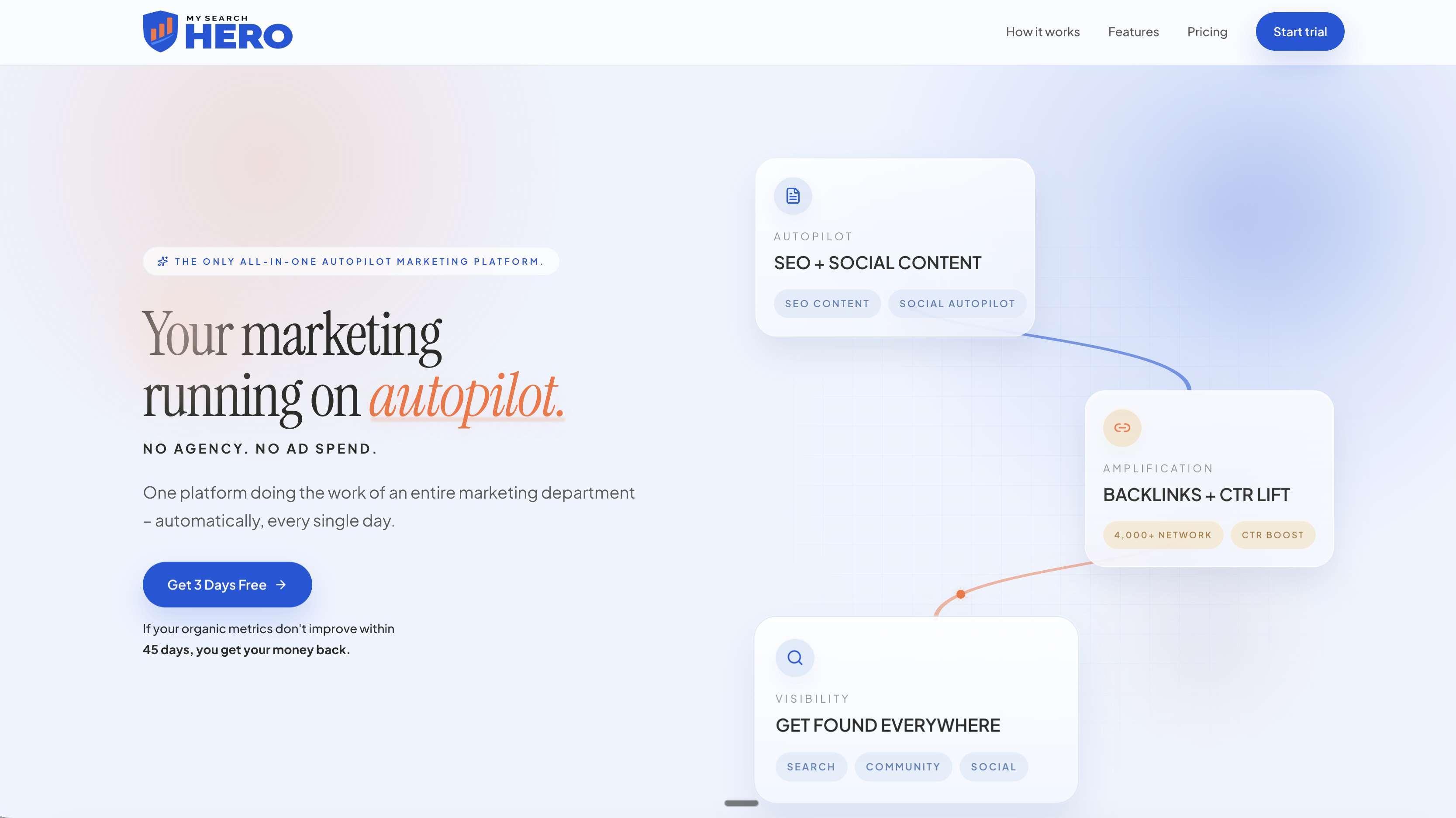
Your service pages are the foundation. The articles, links and mentions around them are what we keep producing every month so those pages get found.
Our perspective
Most owners we talk to treat the website as a brochure they finished once. Search, and now AI search, treats it as a living record of what your business knows. The business that explains its service most clearly, in the most places, tends to be the one that gets named.
That is why we built MySearchHero around steady output rather than one-off projects. A strong service page is the start. Articles that answer the questions around it, backlinks that point to it, and mentions in the conversations where customers ask for recommendations are what make it credible over time. Doing all of that by hand, alongside running a crew or a clinic, is a lot. Doing it as one monthly bundle, with no ad spend and no agency retainer, is the idea behind the platform.
If you take only one thing from this guide: pick your top service, write the page as if you were answering a customer standing in front of you, and keep adding to it.
Mike
FAQ
What is the difference between an AI service page and a normal service page?
The difference is specificity and clarity. An AI-ready service page covers one service for one type of customer in a named area, answers common questions directly, and shows proof. A normal page often relies on general claims. The more precisely a page states facts, the easier it is for people and AI tools to use.
Do I need special code to appear in AI search results?
No special code is required. Google’s guidance says a page needs to be indexed and eligible to show with a snippet to be a supporting link in its AI features. Structured data such as LocalBusiness markup helps label your details, but the page’s content matters most.
How long should a service page be?
Long enough to answer the customer’s questions, and no longer. For most local services that means roughly 600 to 1,200 words, with headings, a short FAQ and proof elements. Add length only when you have something specific to say.
How do I know if AI tools mention my business?
Run the questions your customers would ask in ChatGPT, Perplexity, Gemini and Google, set to your city. Record whether you appear, whether the facts are correct and which pages are cited. Repeat monthly and compare.
Should every town I serve get its own page?
Only if you can write something true and useful for each one, such as local rules, typical jobs or nearby project photos. Otherwise, list your service area clearly on the main service page.
Sources
- AI features and your website, Google Search Central
- Local Business structured data, Google Search Central
- Local content playbook: From service pages to jobs-to-be-done pages, Search Engine Land