
A local authority backlink is a link to your website from a site that Google associates with your area, your trade, or both: a chamber of commerce, a local news outlet, a supplier, a charity you sponsor. For a plumber, roofer, dentist or landscaper, a handful of these links usually does more for local visibility than dozens of generic ones. The catch is that earning them is steady, repetitive work, and that is why many owners stall after the first two or three. This guide covers what counts, where to find the links, how to avoid the ones that cause trouble, and how to keep the work running every month.
TL;DR
- A local authority backlink is a real hyperlink from a site tied to your city, region or industry. A citation (your name, address and phone number listed somewhere) is different, though one page can be both.
- Relevance beats raw authority scores. A link from a local team, association or supplier you actually work with can outweigh a big, unrelated site.
- The best sources are local organizations, sponsorships, partner businesses, local press and your own locally specific content.
- Never buy links to manipulate rankings, and review your link profile in Google Search Console.
- Consistency matters more than any single link, which is why we run backlinks, articles and Reddit mentions as a monthly routine.
Table of Contents
- What a local authority backlink actually is
- Why local links matter for a service business
- What makes a local link “authority” quality
- Where to find local authority backlinks
- How to find the prospects yourself
- Link-building mistakes that put rankings at risk
- How to check the links you already have
- A realistic monthly routine
- Perspective
- Putting it on autopilot
- FAQ
- Sources
What a local authority backlink actually is
A backlink is a clickable link from another website to yours. It works as a vote of confidence: someone else vouches for you by pointing visitors your way. “Authority” means the linking site is trusted and has an audience. “Local” means the link comes with geographic or industry context that tells Google where you operate and what you do.
Three examples for a service business:
- A local news site mentions your HVAC company in a story about a heat wave and links to your service page.
- The youth baseball league you sponsor lists you on its sponsors page with a link.
- A tile supplier you buy from lists you as a recommended installer.
None of these needs a huge domain score. Each one tells search engines the same thing: this business is real, active and part of this community.
Backlinks versus citations
The two get mixed up constantly. A citation is a mention of your business name, address and phone number, typically on a directory. Its main job is confirming that you exist and keeping your details consistent. A backlink connects two websites and can pass authority, relevance and visitors. A citation can include a link, and a backlink can mention your business without a full address. You want both, and they do different work.
Why local links matter for a service business
Google’s local results lean on relevance, distance and prominence. You cannot change distance. Prominence, which reflects how well known and trusted you are online, is where links, reviews and brand mentions pay off.
Local ranking is also not the same as national ranking. Mailchimp’s local SEO guide explains that Google’s local algorithm generally gives more weight to links from businesses and organizations influential in your area. Its example is a small-town plumber: traffic from local residents is worth far more than traffic from people who can never buy the service.
Search Engine Journal makes the same point from the practitioner side. In a write-up of a talk by local SEO specialist Greg Gifford, it describes how sponsoring a local little league team can give an orthodontist a link with real local relevance, while also putting the practice in front of families who live nearby. That is the double payoff of a good local link: a ranking signal and a referral source.
There is also a mechanism behind this. A UK trade-focused analysis in Link Building Journal, citing a 2026 survey of local SEO experts, puts link signals at roughly a quarter of local organic ranking weight, while Google Business Profile dominates the map pack. Treat the exact percentages as one expert panel’s view. The practical reading is simple: your profile gets you into the map pack, and your pages and links decide how you do in the regular results below it.
What makes a local link “authority” quality
Owners often ask for a number: how much domain authority is enough? Local SEO does not work that way. Judge a link on four things.
- Local relevance. Does the site belong to your city, county, neighborhood or state? Is the audience people who could hire you?
- Topical relevance. Is the page about your trade, your suppliers, your customers’ problems or the community around them?
- Real audience. Is the site active, with fresh content and visitors, and does it link out to other businesses?
- Natural placement. Does the link sit inside useful content on a relevant page, pointing to the page that best matches the context?
A link-building journal analysis frames it as how much a link “makes sense”: a community site in your city linking to a local tradesperson is a coherent signal, while an unrelated big foreign site is a louder voice saying something less relevant. Local specialists also point out that a link that looks worthless in a national campaign can be valuable locally, and that follow versus nofollow matters less than whether real local customers will see the link.
One more principle from practitioners: spread your links across several kinds of sources rather than leaning on one great placement. A profile built from a single source looks thin, and one lost link hurts more.
Where to find local authority backlinks
Here is where service businesses usually find them, roughly in order of effort.
Organizations you already belong to
Chamber of commerce, trade associations, a Better Business Bureau profile if you are accredited, and manufacturer or supplier “find an installer” pages. Check that your membership profile links to your site and points to the right page, not a homepage that has nothing to do with your service.
Sponsorships and community involvement
School teams, charity runs, local festivals and neighborhood associations often list sponsors with links. These are worth more than the link alone because they put your name where local customers look. Ask for a link to your most relevant service page, or to a page about your community work.

Local partner businesses
Search Engine Journal’s coverage of local partnerships explains that reputable neighboring businesses can validate your existence, expertise and authority by linking to you. The example: an auto body shop linking to a full-service mechanic. Even a link that is not specific to your service still confirms you are a real local business. Think of realtors, home inspectors, interior designers, property managers, suppliers and complementary trades.
Local press and bloggers
Pitch a story only when you have one: a local data angle, a seasonal warning, an expert comment on a news event. A roofer who publishes what a storm did to homes in specific neighborhoods gives reporters something to cite. Also look for local “best of” roundups and event listings where you belong.
Your own locally specific content
Links follow content that deserves them: a neighborhood guide, a local cost breakdown, a permit explainer for your city. The other four sources are easier when you have a page worth linking to. If you want to see how this plays out with steady publishing, our piece on small business SEO that builds authority backlinks walks through it.
How to find the prospects yourself
If you are building links by hand, search the way a local would. Combine your city or county with your industry and words like “blog”, “news”, “directory”, “sponsors”, “association” or “resources”. Look at who links to the businesses ranking above you, then ask a simple question about each site: would a link to my business make sense here, and what does it give that site’s audience?
For each prospect, write down the site, the exact page you would want a link to appear on, and why it helps their readers. An outreach email that explains the benefit to their audience gets answered far more than one that asks for a favor. Follow up once, politely, and move on.
Link-building mistakes that put rankings at risk
Google’s spam policies list buying or selling links for ranking purposes as link spam. Paid links are acceptable only when they are marked with a rel=“nofollow” or rel=“sponsored” attribute. Sponsorships are fine because you are paying for the sponsorship and exposure, not for a ranking boost, but be wary of anyone selling links in bulk.
Other common problems:
- Chasing volume. Fifty irrelevant links are worth less than five that make sense.
- Repeating exact-match anchors. Natural links use your business name, a plain phrase or a page title.
- Pointing everything at the homepage. Link to the service page that matches the context.
- Ignoring what already links to you. Spammy links from random sites can pile up over time.
How to check the links you already have
This is the tracking step most owners skip, and it is free. Google’s Search Console has a Links report that shows who links to your site, your top linked pages and your top linking text. Once a quarter, open it and look at three things:
- Top linking sites. Do you recognize them? Are they local or relevant?
- Top linked pages. Are links reaching your service pages or only the homepage?
- Top linking text. Watch for off-topic anchors.
Search Engine Land’s guide on negative SEO suggests checking Top linking sites for suspicious domains linking to many of your pages, and top linking text for anchors like casino or online pharmacy. Visit any odd-looking site and decide whether the link looks spammy.
To track impact, log the date each link goes live, then watch three numbers over the following months: impressions and clicks for the linked page in Search Console, calls and form fills from local visitors, and your position for your main “service plus city” searches. Links take weeks to show effect, so judge trends over a quarter, not a week.
A realistic monthly routine
Local links are not a one-time project. A workable rhythm for an owner doing it alone looks like this:
| Week | Task |
|---|---|
| 1 | Publish one locally useful page or post worth linking to |
| 2 | Pitch two or three relevant local sites or partners |
| 3 | Follow up, claim sponsor or member links, fix links pointing to the wrong page |
| 4 | Review Search Console and note what moved |
The hard part is not knowing what to do. It is doing it every month while you run jobs, quote work and manage a crew. That is the gap a done-for-you service fills. For more on the sorts of links worth pursuing, see our guide to the best backlink types for local SEO and our walkthrough on getting backlinks that actually boost rankings. If you are working through the bigger picture, the local SEO checklist shows where links fit with your profile, pages and reviews.
Perspective
Most service business owners we talk to do not fail at link building because they pick the wrong tactics. They fail because the work is a monthly habit, and a busy week kills the habit. One good chamber link is nice. Six months of steady articles, authority backlinks and local mentions compound.
That is why we built MySearchHero as one pipeline instead of five separate vendors. Each month, subscribers get published articles on their own site, authority backlinks through our publisher network, Reddit brand mentions in relevant conversations and AI-generated social posts, with reporting so you can see what went out. Content gives people a reason to link, backlinks build authority, and the other pieces keep your name visible where customers look.
Our advice stands either way: pursue the local relationships only you can build, like sponsorships, suppliers and neighbors, and let the pipeline carry the recurring work.
Mike
Putting it on autopilot
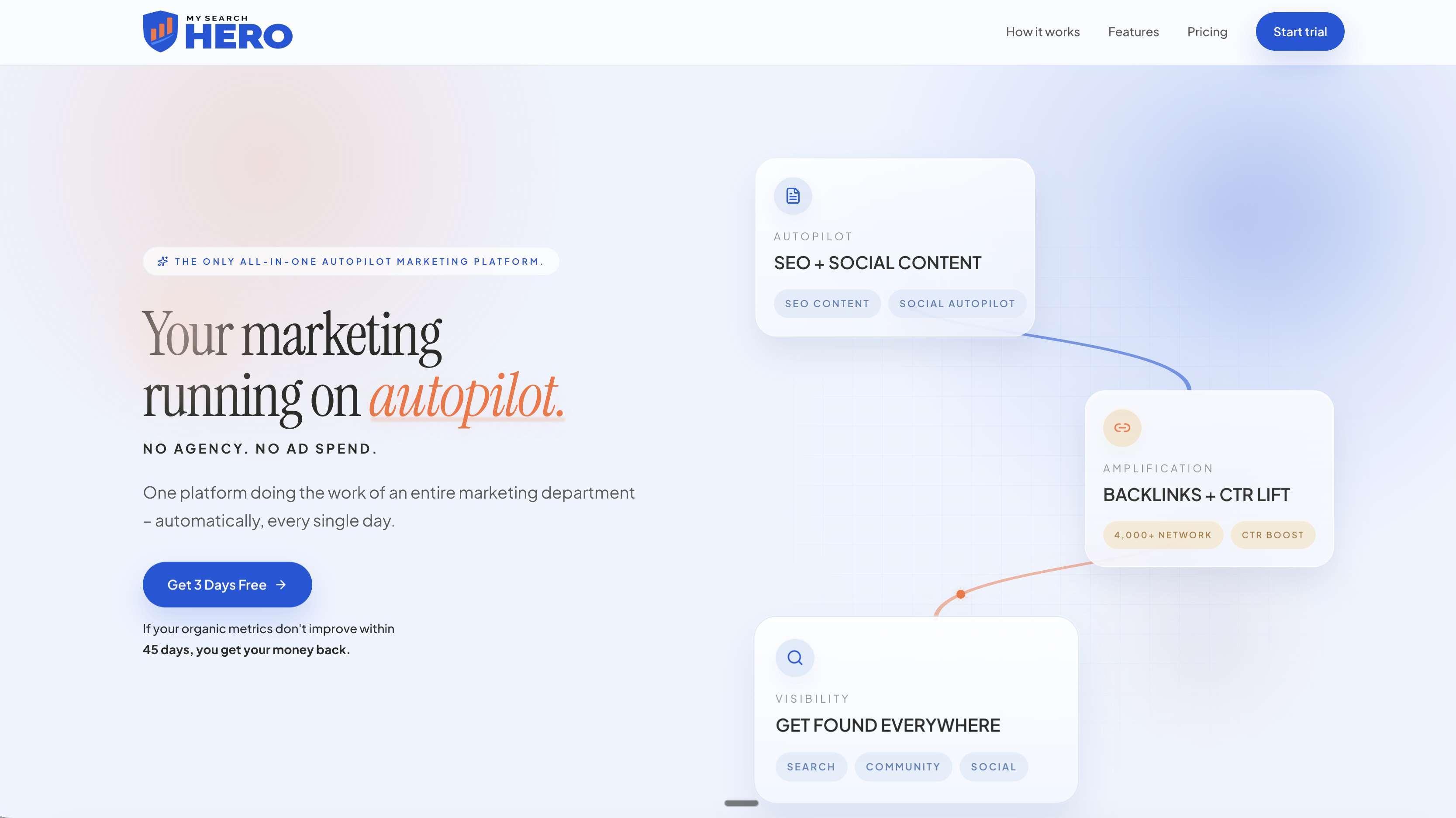
If you would rather not run this routine yourself, MySearchHero bundles SEO articles, authority backlinks, Reddit mentions and social posts into one monthly subscription. Plans are Spark at $197 per month, Authority at $297 per month and Hero at $397 per month, with annual billing at $1,970, $2,970 and $3,970 respectively. Hero combines SEO, backlink building, CTR boosting, Reddit presence and automated social posting, and it comes with a 45-day money-back guarantee if organic metrics do not improve. Subscriptions begin with a free trial. See the plans on the MySearchHero site.
If you want to understand how backlinks and articles work together first, read about the benefits of backlinking or how to grow local traffic for service businesses.
FAQ
How many local backlinks does a service business need?
There is no magic number. Look at the businesses ranking above you for your main service and city, and see how many relevant local sources link to them. Aim to match their mix of local, industry and community links over time, not their raw count.
Are local citations the same as backlinks?
No. A citation mentions your business name, address and phone number, mainly to confirm that you exist and keep your details consistent. A backlink is a hyperlink that connects your site to another and can pass authority. A directory listing can be both when it includes a link.
Do nofollow links help?
They can. Local specialists advise not treating follow versus nofollow as gospel when a link puts you in front of real local customers. Google also expects paid or sponsored links to be marked with nofollow or sponsored attributes, so a mix is normal.
How long do local backlinks take to affect rankings?
Expect weeks to months, not days. Track the linked page’s impressions, clicks and calls in Search Console and your phone logs, and judge the trend over a quarter.
Sources
- How Inbound Links Help Local SEO | Mailchimp
- How to Build Authority in Local SEO | Search Engine Journal
- Using Local Business Partnerships And Collaborations | Search Engine Journal
- Local Service Link Building | Link Building Journal
- Spam policies for Google web search | Google Search Central
- Links report | Search Console Help
- What is negative SEO? | Search Engine Land