
Multi-location content is the set of web pages, posts and profile text that tells search engines and customers what you do in each place you serve, without your locations competing against each other. The working rule: one team owns the brand-wide content, each location gets its own useful page with details only that location can give, and every topic has a single owner. A steady monthly content supply helps you keep that up, and our Hero plan is built to supply it for $397 per month.
TL;DR
- Keep brand-wide content (core services, company story, general advice) in one place, and give each real location its own page with its own details.
- Make location pages useful, not just different: address, hours, services, local reviews, photos and a clear way to call or book.
- Decide who owns each keyword before you write, so two of your pages never chase the same search.
- Create only as many pages as you can keep accurate and useful. More URLs do not mean more rankings.
- Measure each location separately: rankings, page visits, Google Business Profile activity and real leads.
Table of Contents
- What multi-location content actually is
- Split the work: brand-level versus location-level
- What each location page needs
- Keep your locations from competing with each other
- Keep your business details identical everywhere
- Plan content as a team, even if the team is two people
- How to measure each location
- Perspective
- Where MySearchHero fits
- A 30-day starter plan
- FAQ
- Sources
What multi-location content actually is
If you run a plumbing company with three branches, a dental group with five offices, or a landscaping crew that serves four metro areas, you have a content problem a single-location business does not. Someone searching “plumber near me” in one suburb needs to find the page for the branch that serves that suburb, not a generic company page.
Multi-location content covers everything that makes that happen:
- Location pages, one per real place you operate or serve.
- Service pages that explain what you do, either company-wide or adapted by location.
- Local posts and FAQs that answer questions people in that area ask.
- Profile and listing text, such as your Google Business Profile, that must match your website.
A professional analysis from Localogy argues that it now takes more than complete Google Business Profiles and a basic brand website: multi-location brands need content that matches local search intent to stand out in traditional results and in AI-generated answers. Content that does not help the searcher do what they came to do will neither rank nor convert.
Split the work: brand-level versus location-level
The most common mistake is writing the same material over and over for every location. The second most common is leaving everything vague and shared. Search Engine Land’s guidance on this gives a clean split.
Corporate content covers broad informational blog posts, core service and product pages, and company history, leadership, mission and differentiators. Local content covers location landing pages with unique copy, localized metadata, location-specific FAQs and structured data such as reviews and LocalBusiness markup. (Structured data is code on a page that tells search engines plainly what it is: a business, its address, its hours.)

Without that clarity, the same source warns, multi-location brands risk competing with themselves in search instead of winning. Two of your own pages fighting for “AC repair in Tampa” helps nobody but your competitors.
A simple ownership test
Before writing anything, ask three questions:
- Is this topic specific to one location or region, or does it apply everywhere?
- Who should own the keyword: the brand page or a location page?
- Is another page already targeting it?
Those are the pre-creation questions Search Engine Land recommends, paired with a centralized content calendar so topics do not overlap. For a small business, the calendar can be a spreadsheet with four columns: topic, target phrase, owner page, publish date.
What each location page needs
Each real location deserves its own page with its own URL. A single “Locations” directory listing addresses is not enough. Localogy lists what a strong location page includes:
- Name, address and phone number (together called NAP)
- Hours, including holiday hours
- Location-specific service descriptions
- Local reviews and testimonials
- A map embed or directions link
- A clear call to action such as “Book Now” or “Call Now”
For service businesses, add the details that make a local customer trust you:
- Licenses or certifications specific to that area
- Photos of actual jobs in the neighborhood
- Pricing ranges
- A short “why choose us” written for that area
- Local blog posts and FAQs that mention local conditions such as climate or common problems. Localogy notes these are more likely to show up in AI-generated summaries, voice search answers and featured snippets.
What “unique” really means
Owners often worry about a magic percentage of unique text. There is none. Search Engine Land’s guide to structuring geographic pages says there is no universal figure: repeating an identical booking process is fine, while different teams, parking, hours and service availability should be handled locally. The same piece says generic city histories, nearby attractions and paragraphs calling every community “vibrant” do not establish local relevance.
A quick test: cover the city name on the page. If a customer in another town could read it and find it equally true, it is not local content yet.

Worked example
Say you run “Brightline HVAC” with offices in Tampa and Orlando. Both pages share the same booking process and warranty language, which is fine. The Tampa page adds what is true only there: the neighborhoods your trucks cover, how humidity and salt air affect coastal systems, the technicians based at that office, its hours, and reviews from Tampa customers. The Orlando page does the same with Orlando facts. Neither page is a copy with a swapped city name.
Keep your locations from competing with each other
Two habits cause most self-competition: creating a page for every nearby town you barely serve, and writing near-identical blog posts for each location.
Search Engine Land’s advice is to create the smallest number of pages necessary to accurately represent the business, then make those pages useful, connected and authoritative. In other words, scale clarity, not URL count. If you want to see how larger brands approach generating many local pages safely, our guide on safely scaling programmatic local pages walks through it.
The practical rules:
- One page per real location or clearly defined service area you can serve well.
- Brand-wide questions (“how does water heater maintenance work?”) live on one shared page that every location page links to.
- Location posts cover things that really differ: local regulations, weather, events, neighborhood projects.
- Do not create a second website for each location. Separate sites split your authority and multiply the maintenance.
Keep your business details identical everywhere
Search engines check whether your name, address and phone number match across your site, Google Business Profile and directories. Search Engine Journal points out that this consistency matters down to “St.” versus “Street”, because matching details across sources help validate that a business exists. It also recommends unique local schema for each location and a Google map linked to the Google Business Profile on service-area pages.
For each location, pick one written format for the address and phone number, and paste that exact version everywhere. Our walkthrough on fixing NAP mismatches with local business schema shows how to do the markup in about 15 minutes.
Reviews feed your location pages too, and they need to be genuine. If a fake or retaliatory review lands on a profile, the process for Google review removal for businesses is its own track, separate from your content work.
Plan content as a team, even if the team is two people
Multi-location brands need a shared governance plan for ownership, keyword targeting and collaboration, according to Search Engine Land. For a small company, that can be as simple as:
| Decision | Who decides | Where it is recorded |
|---|---|---|
| Brand voice and core service wording | Owner | One-page style note |
| Which keyword goes to which page | Owner or marketing lead | Content calendar |
| Local details (hours, staff, parking) | Location manager | Location page checklist |
| Local photos and reviews | Location manager | Shared folder |
Keep the fixed parts fixed (name, logo, service descriptions, guarantees) and let the local parts flex (photos, offers, contact details, hours). Reserve approval steps for risky content, such as legal claims or licensing statements, and let routine posts go out without waiting on anyone.
How to measure each location
Do not judge your content by total website traffic alone. A strong location can hide a weak one. Track each location with the same set of numbers:
- Search visibility: where the location appears for local phrases such as “plumber near me” or “[service] in [city]”.
- Page performance: visits, clicks and form fills on each location page, from Google Analytics and Google Search Console (both free tools from Google).
- Google Business Profile activity: views, calls, direction requests and website clicks.
- Business outcomes: booked jobs and revenue linked to each location.
Review them monthly in one sheet, location by location, and keep the metrics side by side instead of blending them into one score. A location with fewer calls may simply have a full schedule.
Perspective
Most owners we talk to with more than one location do not have an SEO problem so much as a consistency problem. The work that wins local search is not glamorous: a useful page for each place, honest local details, fresh articles that answer real questions, and mentions around the web that point back to you. It has to happen every month, not in one burst before a redesign.
That is why we built MySearchHero around a monthly bundle: published articles, authority backlinks, Reddit mentions and social posts, delivered through an automated pipeline. Our approach is designed to build visibility that compounds without ad spend or an agency retainer. For a busy owner juggling crews, schedules and customers in several towns, steady output beats occasional heroic efforts.
Use the ownership rules above to decide what each piece of content is for, then keep the supply going.
Mike
Where MySearchHero fits
Once your page structure and ownership rules are set, the ongoing job is steady content and authority. MySearchHero is a done-for-you service for local and service-based businesses: each month, subscribers receive AI-generated SEO articles published to their website, authority backlinks through a publisher network, Reddit brand mentions in relevant conversations, and AI-generated social posts across platforms, with reporting included.
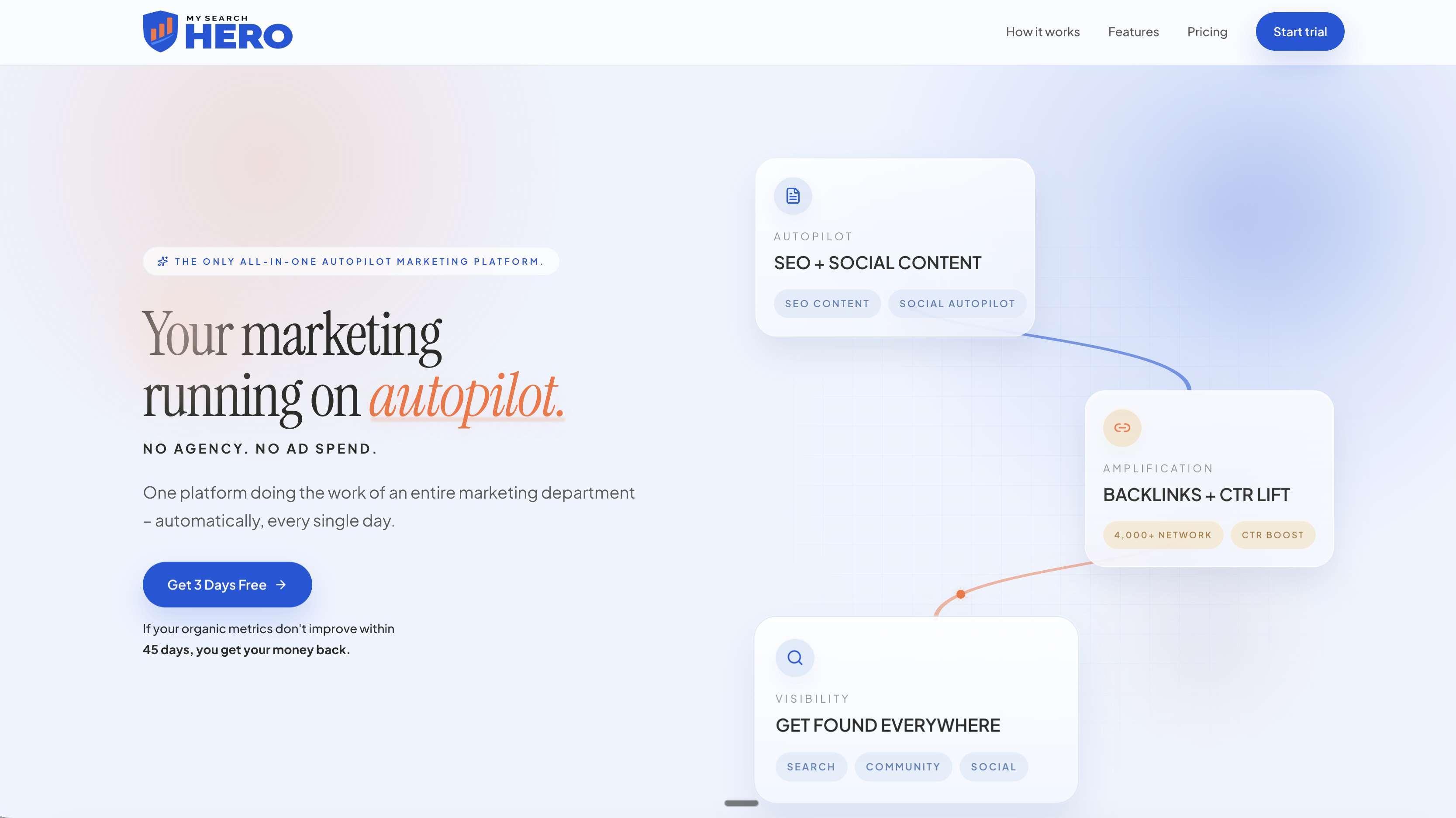
Plans start with Spark at $197 per month ($1,970 per year), Authority is $297 per month ($2,970 per year), and Hero, which combines SEO, backlinks, CTR boosting, Reddit presence and social posting, is $397 per month ($3,970 per year). Hero comes with a 45-day money-back guarantee if organic metrics do not improve. You can see every plan on the MySearchHero pricing page.
A 30-day starter plan
You do not need to fix everything at once. A realistic first month:
- Week 1: List every real location and service area. Decide which get their own page. Write one standard format for each address and phone number.
- Week 2: Build or rework each location page using the checklist above: hours, services, staff, directions, photos, reviews, a clear call to action.
- Week 3: Set up your content calendar with an owner for each keyword. Add local schema and link each Google Business Profile to its page.
- Week 4: Publish your first local posts or FAQs, and set up the monthly per-location scorecard.
For more tactics to layer on top, see our local SEO checklist, the broader multi-location SEO guide and these content ideas for local businesses.
FAQ
Can I have two websites for one business?
You can, but for most local service businesses it is the weaker setup. Separate sites split your authority and double the upkeep. One site with a dedicated page for each location keeps your reviews, links and content working together.
Does every location page need completely unique text?
No. There is no required percentage. Shared material such as your booking process or company boilerplate can repeat. What must differ is what differs in real life: staff, hours, parking, service availability, local reviews and local conditions.
How many location pages should I create?
As few as accurately represent your business. Create one for each real location or well-defined service area you can describe in useful detail. Pages for towns you do not meaningfully serve add maintenance and can compete with your better pages.
How often should I publish location content?
A steady monthly rhythm works better than occasional bursts. Fresh local posts, FAQs and updates to hours and photos show customers and search engines that each location is active. Plan the topics in a shared calendar so nothing overlaps.
Sources
- Multi-location Content That Matches Local Search Intent, Localogy
- Multi-location SEO strategy: Stop competing with your own content, Search Engine Land
- Multi-location SEO: How to structure geographic pages, Search Engine Land
- 6 Types of Duplicate Content in Local SEO, Search Engine Journal
- Google Review Removal for Businesses