
TL;DR:
- Content quality directly impacts search engine rankings and domain authority, especially for informational searches.
- Google evaluates content based on expertise, experience, trustworthiness, and relevance, requiring original and thorough material.
Content is the primary mechanism through which search engines understand, rank, and recommend your website to relevant audiences. Without it, even the most technically sound site is invisible. The role of content in SEO goes far beyond filling pages with words. Google’s Helpful Content system and E-E-A-T framework now evaluate content quality at the site level, meaning every article you publish either builds or erodes your domain’s ranking potential. This guide explains exactly how content quality, structure, and strategy drive search visibility, and what business owners and marketers need to do differently in 2026.
How does content quality affect search rankings?
Content quality directly correlates with higher Google rankings, especially for informational queries. An analysis of 44,000 pages found that content quality independently explains 7% of ranking variation. For informational queries, quality matters 2.5 times more than it does for commercial queries. That gap is significant. It means a business blog answering customer questions needs to be genuinely excellent, not just keyword-rich.
Google evaluates quality through its E-E-A-T framework: Experience, Expertise, Authoritativeness, and Trustworthiness. These are not abstract ideals. They show up in concrete signals: named authors with credentials, cited sources, original research, and content that matches what the searcher actually needs. A page written by a generalist with no sourcing scores poorly on every dimension.
The elements that define quality content are specific:
- Originality: The content presents a perspective, data point, or example not found elsewhere.
- Relevance: The content directly answers the query without padding or tangents.
- Depth: The content covers the topic thoroughly enough that the reader does not need to search again.
- Coherence: Ideas flow logically from one paragraph to the next without repetition or contradiction.
High-effort content also earns backlinks indirectly. Unique content attracts links that build domain authority, which remains the dominant ranking factor. Publishing a proprietary study or expert interview gives other sites a reason to cite you.
Pro Tip: Focus each page on one cohesive topic. Pages that try to cover five related subjects rarely rank well for any of them. Depth on a single topic beats breadth across many.
Human-written vs. AI-generated content: what ranks better?
Human-written content holds a clear ranking advantage over fully AI-generated content. Human-written content is 8 times more likely to rank in the top position on Google, with an 80.5% probability of holding first place. That figure comes from an analysis of 42,000 blog posts in 2026. The gap is not marginal. It reflects something structural about how Google evaluates trust and originality.

AI content can produce short-term gains. A 16-month longitudinal experiment showed that fully AI-generated content achieves early indexing and traffic, but rankings collapse within months without human editorial input and E-E-A-T signals. The content gets indexed because it is technically coherent. It loses rank because it lacks authority and uniqueness.
Google’s official position is clear: production method alone is not a ranking factor. Quality, originality, and user value are what matter. That means AI-assisted content can rank well, but only when a human editor adds genuine insight, verifies facts, and shapes the final voice.
The practical approach for marketers:
- Use AI tools to accelerate research, generate outlines, and produce first drafts.
- Assign a human editor to rewrite, add original examples, and verify every claim.
- Add author bios, credentials, and sourced data before publishing.
- Audit AI-generated pages quarterly to catch content that is losing rank.
Pro Tip: AI is a research and drafting accelerator, not a publishing pipeline. Every piece that goes live should have a human fingerprint on it, whether that is a named author, a proprietary insight, or a real-world example no AI could have generated.
For a deeper look at how AI fits into a small business content plan, the AI and content guide from Mysearchhero covers the 2026 landscape in detail.
What is Google’s Helpful Content system and why does it matter?
Google’s Helpful Content system is a site-wide quality classifier, not a page-level filter. The system suppresses rankings across entire domains that carry significant volumes of thin, SEO-first content. A single excellent article cannot rescue a domain full of low-value pages. The classifier evaluates the ratio of helpful to unhelpful content across the whole site.
This has a practical consequence most business owners miss. Publishing 50 generic, keyword-stuffed posts to “feed the algorithm” can actively harm the 10 genuinely good articles already on your site. A poorly optimized site with too much unhelpful content suppresses rankings for even high-quality pages on that domain. Volume without quality is a liability.
Recovery from a Helpful Content penalty requires site-wide improvement, not just adding new good content. Google’s classifier needs to see the overall ratio shift before it lifts suppression. That process takes months.
To pass the Helpful Content assessment, follow these practices:
- Write every page for a specific human reader, not for a search engine crawler.
- Remove or consolidate thin pages that add no unique value.
- Update outdated content with current data and examples.
- Add author credentials and sourced references to every substantive article.
- Audit your site annually to identify pages with high bounce rates and low engagement.
Pro Tip: Before publishing new content, ask: “Would a reader bookmark this?” If the honest answer is no, the page is not ready. Thin content that passes a keyword check but fails a human check is exactly what the Helpful Content system targets.
Practical SEO content strategies for business owners
SEO content writing differs from regular blogging by its deliberate incorporation of keyword targeting, metadata structuring, and internal linking. These technical layers make content discoverable, not just readable. A well-written article with no metadata and no internal links is invisible to search engines regardless of its quality.
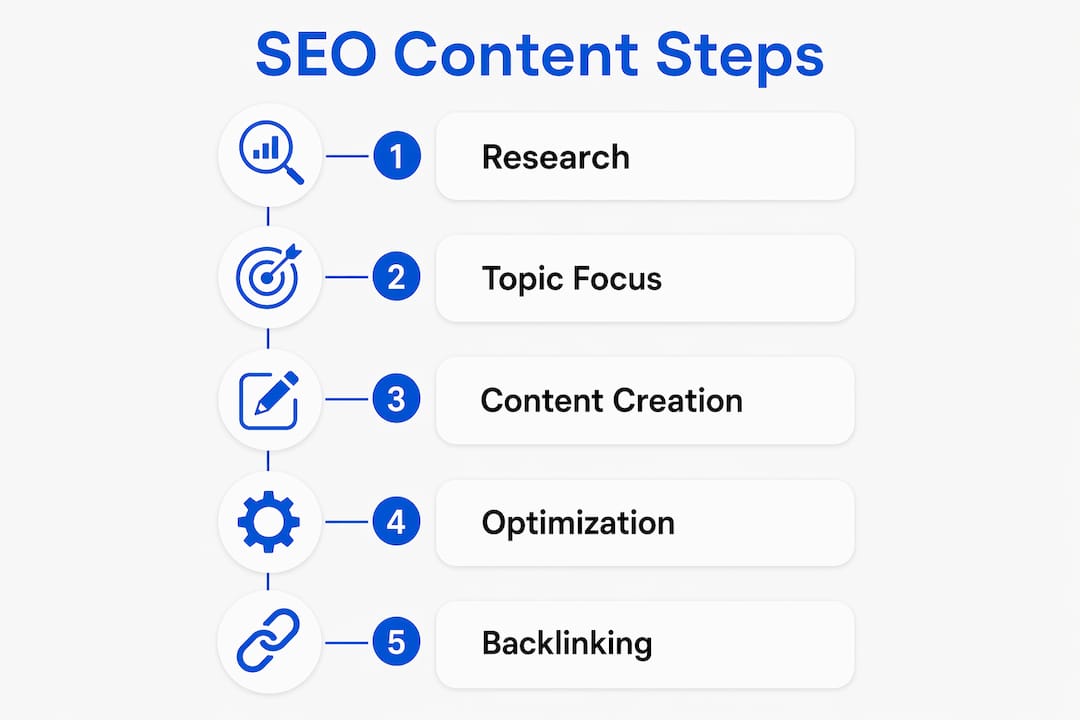
The workflow that produces ranking content follows a clear sequence. Research comes first: identify the query, understand the searcher’s intent, and map the topic to a specific page. Drafting comes second, with a focus on depth and originality. Editorial refinement comes third, where a human editor checks facts, improves clarity, and adds E-E-A-T signals. Performance measurement comes last, tracking rankings, click-through rates, and time on page to identify what needs updating.
Internal linking deserves more attention than most marketers give it. Linking related pages together helps Google understand your site’s topical structure. It also keeps readers on your site longer. A page about content marketing workflows should link to related pages on keyword research and content planning. That network of links signals topical authority.
The table below compares two core content types by their SEO purpose and execution requirements:
| Content type | Primary SEO purpose | Key execution requirement |
|---|---|---|
| Informational (guides, explainers) | Rank for research queries, build topical authority | Depth, sourced data, E-E-A-T signals |
| Transactional (product pages, landing pages) | Rank for purchase-intent queries, drive conversions | Clear intent match, structured metadata, trust signals |
Citable content earns backlinks without outreach. Publishing original research, expert interviews, or data-driven guides gives journalists and bloggers a reason to link to you. Those links build domain authority, which amplifies the ranking power of every other page on your site. A single well-researched study can generate more backlinks than 20 standard blog posts.
For a broader view of how different SEO strategies fit together, Mysearchhero’s 2026 marketer guide covers the full picture.
Key Takeaways
Content quality is the single most controllable variable in SEO, and every piece you publish either strengthens or weakens your domain’s ranking potential across the board.
| Point | Details |
|---|---|
| Quality over quantity | Content quality explains 7% of ranking variation; thin content harms the whole domain. |
| Human editing is non-negotiable | Human-written content is 8 times more likely to rank first than fully AI-generated content. |
| Helpful Content is site-wide | One bad page does not fail alone; a high ratio of unhelpful content suppresses all pages. |
| SEO content requires technical layers | Keyword targeting, metadata, and internal linking make quality content discoverable. |
| Citable content builds authority | Original research and expert interviews earn backlinks that amplify every page’s ranking power. |
What I’ve learned after watching content strategies succeed and fail
The businesses I see struggle most with SEO share one pattern: they treat content as a volume game. They publish frequently, cover every keyword variation, and measure success by post count. Their rankings plateau or drop. The businesses that grow consistently do the opposite. They publish less, invest more in each piece, and treat every article as a long-term asset.
The AI content debate frustrates me because it misses the real question. The question is not “human or AI?” The question is “does this page earn the reader’s trust?” I have seen human-written content that is lazy, generic, and useless. I have seen AI-assisted content that, after serious editorial work, ranks well and serves readers genuinely. The production method is irrelevant. The output quality is everything.
Google’s Helpful Content system changed the calculus permanently. You cannot quarantine bad content anymore. A site full of thin pages drags down the good ones. That means every content decision is a domain-level decision, not a page-level one. Business owners who understand this stop asking “how many posts should we publish this month?” and start asking “which pages are hurting us?”
The practical lesson: audit before you create. Most sites have more to gain from improving or removing existing content than from publishing new content. A content audit that identifies and fixes 20 underperforming pages will often outperform six months of new publishing.
— Mike
How Mysearchhero handles content SEO for you
Mysearchhero is a done-for-you SEO and content marketing service built for business owners and marketers who want results without managing the process themselves.
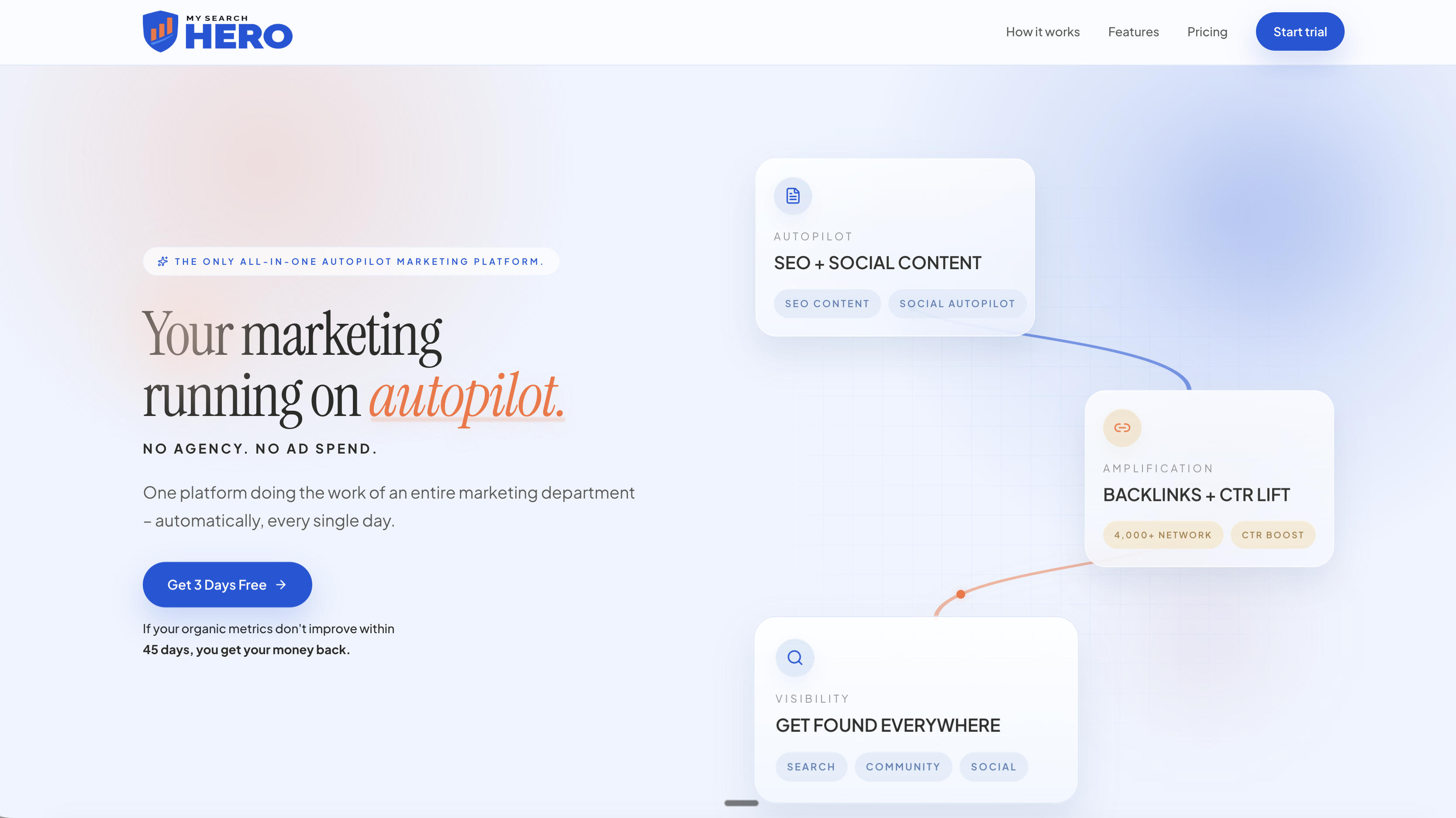
Each month, subscribers receive published articles, backlinks, Reddit mentions, and social media posts, all pushed through a fully automated pipeline. Every article is written with E-E-A-T signals, keyword targeting, and internal linking built in from the start. The content quality ratio on your domain improves month by month. If you want your site’s content working harder for your rankings, see how it works at Mysearchhero.
FAQ
What is the role of content in SEO?
Content is the primary signal search engines use to understand what a page is about and whether it deserves to rank. Without quality content, no amount of technical SEO produces lasting visibility.
Does AI-generated content rank on Google?
Google does not penalize content based on how it was produced, but fully AI-generated content without human editing rarely sustains top rankings. Human-written content is 8 times more likely to hold the first position.
What is Google’s Helpful Content system?
The Helpful Content system is a site-wide classifier that evaluates the ratio of helpful to unhelpful content across an entire domain. Sites with high volumes of thin or SEO-first content see reduced rankings across all pages, including good ones.
How does content quality affect domain authority?
High-effort, original content earns backlinks from other sites. Those backlinks build domain authority, which amplifies the ranking power of every page on the domain, not just the page that earned the links.
How often should a business publish new content?
Publishing frequency matters less than content quality. A site with 20 excellent, well-maintained pages consistently outperforms a site with 200 thin posts. Audit and improve existing content before scaling volume.