
TL;DR:
- Online reviews influence about 17 to 20 percent of local search rankings, making them a key SEO factor. Responding promptly and encouraging specific, keyword-rich reviews can significantly boost visibility and rankings through engagement signals. Most businesses overlook the importance of recency, response quality, and review content, missing opportunities to improve local SEO performance.
Online reviews are a direct ranking signal for local search, accounting for roughly 17–20% of local search ranking factors. That makes them the second most influential factor after Google Business Profile optimization and proximity. The role of reviews in SEO extends beyond star ratings. Review volume, recency, keyword content, and response quality all feed into Google’s local ranking algorithm. This guide breaks down every signal that matters and shows you exactly how to use reviews to move rankings.
What aspects of reviews impact SEO the most?
Review signals work through four distinct channels, and most businesses only pay attention to one of them.

Review count and velocity tell Google that a business is active and prominent. A steady stream of new reviews signals ongoing customer engagement. A business with 200 reviews earned over three years looks less active than one with 50 reviews earned over the past six months.
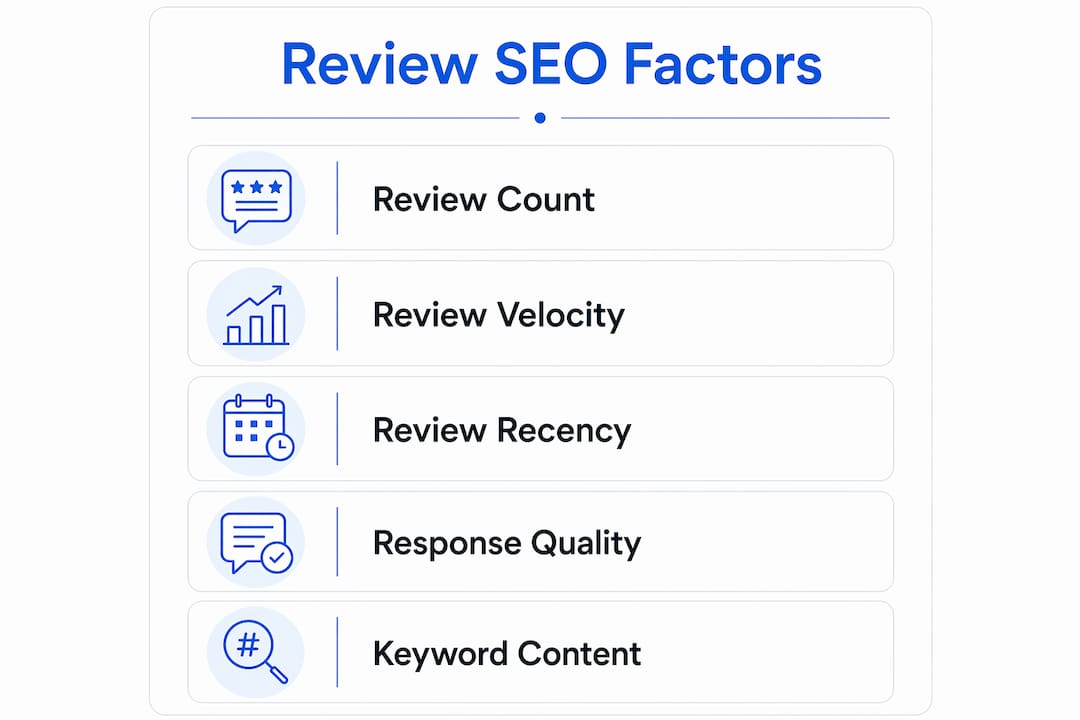
Review recency is the most underweighted factor in most local SEO strategies. Google applies a decay function to older reviews, and local visibility can drop within 60–90 days if a business stops earning new ones. That means a strong review history offers no protection once the pipeline dries up.
Star rating shapes user behavior before a click ever happens. Higher star ratings boost CTR by approximately 25%, and growing review volume from 10 to 100 reviews can increase click-through rate by about 20%. Google reads those engagement signals and adjusts rankings accordingly.
Keyword content inside reviews is the most overlooked channel. When a customer writes “best emergency plumber in Chicago,” that phrase acts as organic keyword injection, reinforcing local relevance for those exact terms without any additional on-site work. You cannot write those words yourself, but you can prompt customers to be specific.
- Ask customers to mention the specific service they received
- Encourage them to name the city or neighborhood
- Request detail about the outcome, not just a generic compliment
- Avoid scripting reviews, which violates Google’s guidelines
Pro Tip: Send a review request within 24 hours of service completion. Customers are most likely to leave detailed, specific feedback while the experience is still fresh.
How do review responses contribute to SEO performance?
Responding to reviews is not just good customer service. It is a direct SEO tactic that most local businesses ignore.
Top local pack profiles use review responses averaging 140 words. Longer, keyword-rich replies correlate with better placement in the local pack. That is a concrete, measurable benchmark most businesses are nowhere near hitting.
Every response you write adds fresh, indexed content to your Google Business Profile. That content reinforces your business category, location, and service keywords. A response to a review mentioning “roof repair in Austin” that includes those same terms in a natural reply strengthens your relevance signal for that query.
Google recommends responding to all reviews within 24–48 hours. Speed signals active management, which Google treats as a trust indicator. Slow or absent responses leave ranking signals on the table.
Best practices for SEO-friendly responses:
- Address the reviewer by first name to personalize the reply
- Reference the specific service or product they mentioned
- Include your business name, city, and service category naturally
- Keep the tone warm and professional, not templated
- Respond to negative reviews calmly and offer a resolution path
Pro Tip: Draft response templates for your five most common review types, then customize each one before posting. This keeps responses fast without making them feel generic.
For a broader look at how review management fits into a full local SEO workflow, the principles apply across markets regardless of geography.
What is the relationship between reviews, user behavior, and search ranking?
Google does not rank businesses based solely on what they say about themselves. It watches how users behave after seeing a result, and reviews drive that behavior directly.
The feedback loop works like this:
- A business earns strong reviews and a high star rating.
- Its listing appears in the Local Pack with a visible rating.
- Higher ratings produce higher click-through rates, as behavioral engagement signals like CTR from the Local Pack validate relevancy for Google.
- Google interprets the higher CTR as a signal that the listing matches user intent.
- The algorithm reinforces the ranking, pushing the listing higher.
- Higher placement generates more impressions and more clicks, compounding the effect.
This loop means reviews do not just influence rankings directly. They shape user behavior, and that behavior feeds back into the algorithm. A business with a 4.8-star rating and 150 reviews will consistently outperform a competitor with a 4.2-star rating and 30 reviews, even if their on-site SEO is identical.
The Local Pack and Google Maps results are especially sensitive to this dynamic. Reviews influence whether a business appears in the three-pack at all, and the three-pack captures the majority of local search clicks. Missing from that box means missing most of the traffic, regardless of how well your website ranks organically.
How to strategically manage and leverage reviews for SEO growth
A passive approach to reviews produces passive results. The businesses that rank consistently treat review acquisition as a repeatable process, not a lucky accident.
Build a consistent acquisition system. Ask every customer for a review after every completed transaction. Use email, SMS, or a direct link to your Google Business Profile. The key word is “consistent.” A steady stream of relevant reviews outperforms a bulk push of old reviews every time.
Prompt for specificity without scripting. Tell customers what to write about, not what to say. “Feel free to mention the service you received and where you’re located” is guidance, not manipulation. Specific reviews generate keyword signals. Generic five-star reviews with no text add volume but little relevance.
Monitor and respond on a schedule. Set a daily or every-other-day review check. Responding within 24–48 hours is the standard Google recommends. Letting reviews sit unanswered for weeks signals neglect to both Google and prospective customers.
Stay inside Google’s guidelines. Never offer incentives for reviews. Never post fake reviews. Never ask employees or friends to leave reviews. Google detects these patterns and can suppress or remove your listing entirely. The short-term gain is not worth the long-term risk.
Integrate reviews into your broader local SEO workflow. Reviews do not work in isolation. Pair them with a complete Google Business Profile, consistent NAP (name, address, phone) data across directories, and quality local content. The local SEO checklist at Mysearchhero covers all twelve ranking signals, including reviews, in a single actionable framework.
| Review action | SEO benefit |
|---|---|
| Consistent new review acquisition | Maintains recency signal, prevents ranking decay |
| Keyword-specific review content | Reinforces local relevance for target search terms |
| Responses averaging 140+ words | Correlates with higher local pack placement |
| Responding within 24–48 hours | Signals active management, builds trust signals |
| High star rating (4.5+) | Boosts CTR, which Google uses as a ranking indicator |
Pro Tip: Add a review request step to your post-service workflow the same way you add an invoice. Make it a business process, not an afterthought.
Key Takeaways
Reviews influence local SEO through recency, volume, keyword content, and response quality, and businesses that manage all four signals consistently outrank those that focus on star ratings alone.
| Point | Details |
|---|---|
| Reviews drive 17–20% of local ranking | They are the second most influential local SEO factor after Google Business Profile. |
| Recency matters more than volume | Rankings can drop within 60–90 days without fresh reviews due to Google’s decay function. |
| Keywords inside reviews boost relevance | Specific customer language reinforces local search terms without extra on-site work. |
| Responses are a ranking tactic | Replies averaging 140 words correlate with stronger local pack placement. |
| CTR creates a ranking feedback loop | Higher star ratings lift click-through rates, which Google reads as a relevance signal. |
Why most businesses are leaving review SEO on the table
Most local businesses treat reviews as a reputation metric. That framing costs them rankings.
After working with local businesses across multiple industries, the pattern is consistent. Owners celebrate a five-star review and move on. They never respond. They never ask the next customer. They never look at what keywords appeared in the review text. The review sits there doing partial work when it could be doing full work.
The recency signal is where I see the biggest gap. A business earns 80 reviews over two years, stops asking, and wonders why rankings slip six months later. Google’s decay function is not a theory. It is a documented behavior, and ignoring it is the single most common local SEO mistake I see.
The response opportunity is equally underused. Writing a 140-word response that naturally includes your service name, city, and a relevant keyword takes four minutes. Most businesses write “Thanks for the kind words!” and call it done. That is a missed ranking signal every single time.
The businesses that treat reviews as an ongoing content and engagement channel, not a vanity metric, are the ones that hold their local pack positions month after month. Pair that discipline with a complete local marketing strategy and the compounding effect becomes very hard for competitors to overcome.
— Mike
How Mysearchhero helps you turn reviews into rankings
Building a consistent review system while running a business is harder than it sounds. Most owners know what they should do. They just do not have the time or the process to do it every week.
Mysearchhero handles the content and visibility side of local SEO on autopilot. Each month, subscribers receive published articles, backlinks, and social posts pushed through a fully automated pipeline. That means your Google Business Profile stays active, your content stays fresh, and your review strategy fits inside a system that runs without you managing every piece. If you want your local SEO running on autopilot, Mysearchhero is built for exactly that.
FAQ
How much do reviews affect local SEO rankings?
Reviews account for approximately 17–20% of local search ranking signals. That makes them the second most influential factor in local pack rankings.
How often should a business get new reviews for SEO?
Google applies a decay function to older reviews, so businesses should aim for a consistent flow of new reviews. Rankings can decline within 60–90 days without fresh activity.
Do keywords in reviews help SEO?
Yes. Customer-written phrases like “best plumber in Denver” act as keyword signals that reinforce local relevance without requiring additional on-site optimization.
Does responding to reviews improve search rankings?
Responding to reviews adds indexed content to your Google Business Profile and signals active engagement. Profiles with responses averaging 140 words show stronger local pack placement.
Can negative reviews hurt SEO?
A few negative reviews do not tank rankings, but a consistently low star rating reduces click-through rates. Lower CTR weakens the behavioral signals Google uses to validate local relevance.