
For most local and service-based businesses, the fastest path to measurable SEO and visibility growth is a single done-for-you pipeline that handles content publishing, backlink delivery, and social distribution every month without you touching it. If you have limited marketing staff and want predictable results, a managed service like Mysearchhero is the right call. If you have a technical team member and one specific bottleneck under five hours a week, a DIY platform can work.
Quick decision rules:
- Choose managed (Mysearchhero) if you want immediate, measurable lift, single-vendor accountability, and monthly deliverables without operational overhead.
- Choose DIY if you have technical staff, a clearly defined single bottleneck, and time to configure and maintain the system.
- Watch your lead handoff. Whether you use Google Reviews automation or Local Services Ads, leads that hit an inbox and wait more than a few minutes tend to disappear.
Table of Contents
- What do the best marketing automation tools actually mean for your business?
- How do you find the single manual bottleneck worth automating first?
- Which marketing automation capabilities do local service businesses actually need?
- What does a realistic 30/60/90-day implementation look like?
- How do you measure whether marketing automation is actually working?
- What pitfalls should you watch for when choosing automation software?
- Why does a done-for-you service often beat DIY for local businesses?
- Key Takeaways
- The gap between what automation promises and what actually matters
- Mysearchhero handles the marketing work you don’t have time for
- Useful sources
- FAQ
What do the best marketing automation tools actually mean for your business?
“Best” depends entirely on your constraints. A feature-rich platform that takes three months to configure is not better than a simpler one live in 48 hours. The criteria that actually matter for local and service businesses:
- Integration quality. Native CRM integrations beat third-party connectors. Every connector is a potential failure point.
- Pricing at scale. Per-contact pricing looks cheap at 500 contacts. Model it at three times your current list to see the real cost as you grow.
- Deliverables clarity. Know exactly what is automated versus what a human reviews. Vague promises create gaps.
- Local SEO capabilities. Content publishing, Google Business Profile signals, and review generation matter more for local businesses than enterprise email sequencing.
- Reporting and attribution. You need to see which channel drove the booked job, not just which email was opened.
- Support and onboarding speed. A platform with slow onboarding costs you revenue during the setup window.
The trade-off between feature-rich platforms and single-purpose tools is real. Broad platforms give you everything but require more configuration time and often charge per contact. Single-purpose tools solve one problem well. Mapping your actual process first before shopping by feature count is consistently the more effective approach.
How do you find the single manual bottleneck worth automating first?
Run this process map before you buy anything:
- List every channel where leads arrive (Google, referrals, social, ads).
- Identify the capture point for each (form, phone call, chat, walk-in).
- Trace where that lead lands (inbox, spreadsheet, CRM, sticky note).
- Document the human action required (call back, email, assign to staff).
- Record the outcome (booked, lost, no response).
Once the map is on paper, score each step by time spent weekly, average response time, and how often a lead disappears at that point. Manual tasks like copying form submissions and delayed responses are among the most common causes of lost leads for small service businesses.
Prioritization checklist:
- Where does a lead wait longest before a human responds?
- Which step requires the most manual copying or data entry?
- Where do you most often discover a lead was never followed up?
- Which task, if automated, would free the most owner or staff time?
Pro Tip: Send a test lead through your own system right now and time every handoff. Most owners find the real leak in the first two touchpoints, usually between form submission and first human response.
A CRM that tracks the full journey from source through engagement to next action is what separates a fixable process from a permanent guessing game.

Which marketing automation capabilities do local service businesses actually need?
| Category | What it handles | When it’s essential |
|---|---|---|
| Lead capture & routing | Forms, chat, SMS intake; instant qualification | Any business missing leads at the first touchpoint |
| CRM & pipeline visibility | Contact records, stage tracking, next-action prompts | As soon as you have more active leads |
| Immediate response | AI chatbots and voice agents that qualify and book 24/7 | High-volume inbound or after-hours inquiries |
| Content & SEO publishing | Monthly articles, keyword targeting, site publishing | Any business wanting organic search visibility |
| Review generation | Automated post-job review requests with one-tap links | All local businesses competing on Google Maps |
| Social content automation | Scheduled posts across platforms from a single queue | Businesses without a dedicated social media person |
| Workflow & integrations | Native connectors between tools; Zapier as fallback | Any multi-tool stack |
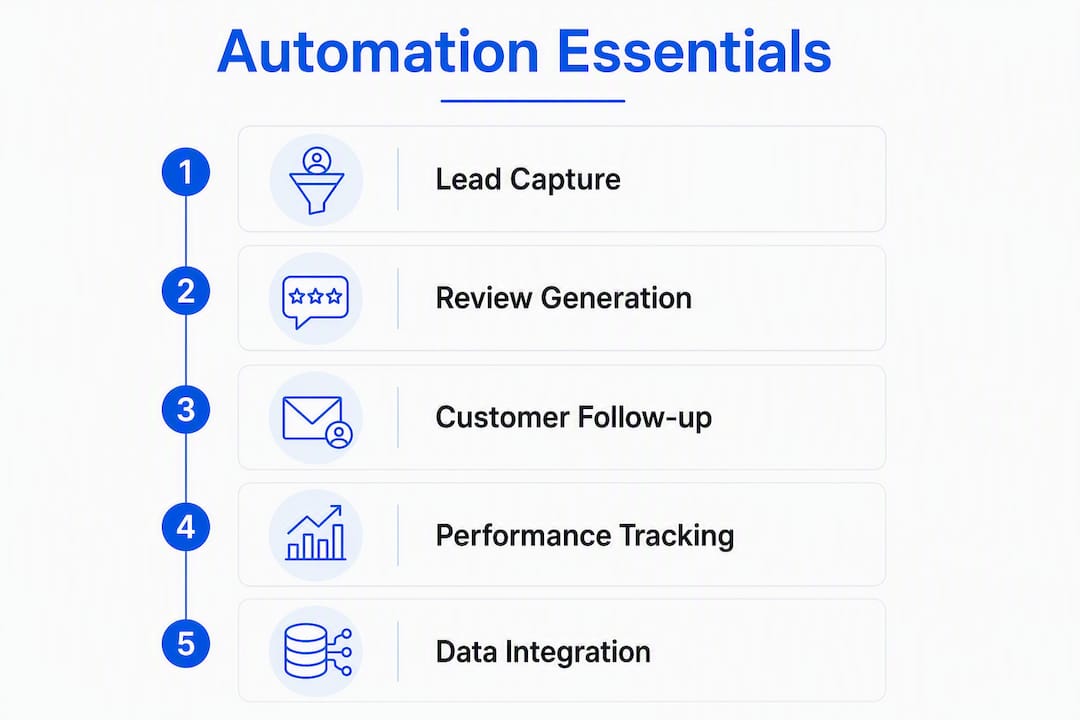
The review generation category deserves specific attention. Automated review requests with a one-tap Google review link can increase monthly review volume by 5x–10x for service businesses. That kind of lift directly affects local pack rankings and conversion rates from Google Business Profile.
What does a realistic 30/60/90-day implementation look like?
Days 1–30: Discovery and mapping
- Complete the process map exercise above with your operations lead.
- Audit your current tech stack (CRM, email, scheduling, social tools).
- Select the single highest-impact automation to build first.
- Confirm native integrations exist between your chosen platform and your CRM.
- Budget for implementation costs separately from software costs. EMyth notes that implementation often costs as much as the software itself.
Days 31–60: Build and pilot
- Configure the first automation (lead capture → CRM → immediate response sequence).
- Run a 14-day pilot with real traffic, not test records.
- Verify CRM sync after every test lead.
- Check automated content for brand voice alignment before publishing.
- Document what remains human-reviewed versus fully automated.
Days 61–90: Scale and refine
- Review KPI baseline versus pilot results.
- Add the second automation only after the first is stable.
- Schedule monthly connector checks to catch broken integrations early.
- For managed services, confirm deliverables are publishing on schedule.
Basic platform setups can go live within 24–48 hours; done-for-you plans reduce onboarding friction further because the configuration work happens on the vendor’s side.
How do you measure whether marketing automation is actually working?
Core KPIs to track:
- Inbound lead volume (weekly)
- First response time (target: under five minutes)
- Qualified lead rate
- Conversion to booked job
- Organic search traffic (monthly)
- Google Reviews volume
- Cost per booked job
A simple ROI check: multiply your average revenue per booked job by the incremental bookings you can attribute to automation, then subtract your monthly platform or service cost. If a $300/month service generates two additional booked jobs at $400 each, the math is straightforward.
| Metric | Typical timeline | Benchmark |
|---|---|---|
| First response time improvement | Days 1–14 | Under 5 minutes with automation |
| Review volume increase | Days 30–60 | 5x–10x with automated requests |
| Lead leakage reduction | Days 30–90 | Up to 70% with a full inbound system |
| Organic traffic lift | Days 60–180 | Varies by content volume and competition |
SEO content takes longer than lead automation. Expect meaningful organic traffic movement at 60–180 days, not 30.
What pitfalls should you watch for when choosing automation software?
Red flags during evaluation:
- Per-contact pricing with no cap (model at 3x your current list before signing)
- No native CRM integration for your existing stack
- Deliverables described vaguely (“we handle your marketing”)
- No pilot period or a pilot shorter than 14 days
- Onboarding that starts building before the architecture is agreed
Mitigation steps:
- Require a written deliverables list before signing anything.
- Test with real traffic during the pilot, not dummy records.
- Set a written SLA for first human follow-up time after a qualified lead arrives.
- Document which messages are automated versus human-reviewed.
- For automated content, review the first three pieces for brand voice before approving full-scale publishing.
The handoff between lead capture and human response is where most local service businesses lose money. A full inbound operating system can reduce lead leakage by around 70%, compared with roughly 10% from a standalone chatbot. Single-threaded inboxes and routing qualified leads to the closer’s preferred channel (phone, text, or email) close that gap.
Pro Tip: Don’t buy based on feature count. Buy to fix one bottleneck well, measure results for 30 days, and only then add the next automation.
Why does a done-for-you service often beat DIY for local businesses?
Building and maintaining a marketing automation stack takes real time: configuring integrations, reviewing automated content, checking for broken connectors, and updating workflows as your business changes. Most local service business owners don’t have that time, and most don’t want to spend it on software configuration.
A done-for-you managed pipeline solves this with single-vendor accountability. You get a fixed monthly deliverables bundle, expert quality review on content and backlinks, and a vendor whose job is to keep the system running.
What a managed pipeline should deliver monthly:
- SEO articles published directly to your website
- Authority backlinks from a publisher network
- Brand mentions in relevant online conversations
- Social media posts distributed across platforms
- CTR signal boosting and a performance report
Who this fits best: owners with limited or no marketing staff, businesses that need local visibility quickly, and anyone who has tried DIY tools and found the maintenance overhead too high.
Mysearchhero is built specifically for this use case…
You can read more about the business case for automated marketing and see practical SMB examples on the Mysearchhero blog.
Key Takeaways
For local and service-based businesses, fixing one operational bottleneck with a done-for-you marketing automation pipeline delivers faster, more measurable results than assembling a DIY tool stack.
| Point | Details |
|---|---|
| Map before you buy | Run a 2-hour process map to find your single highest-impact bottleneck before evaluating any platform. |
| Price at scale | Model per-contact costs at three times your current list to avoid pricing surprises as you grow. |
| Lead leakage benchmark | A full inbound operating system can substantially reduce lead leakage compared to a standalone chatbot. |
| Review volume uplift | Automated review requests can increase monthly Google review volume by 5x–10x for service businesses. |
| Mysearchhero | Delivers monthly SEO articles, backlinks, social posts, and CTR reports as a done-for-you managed pipeline. |
The gap between what automation promises and what actually matters
Most articles about marketing automation tools spend pages comparing feature checklists. The honest reality for a local plumber, HVAC company, or home services business is that 90% of those features will never get used. What actually moves the needle is narrower: does a lead get a response in under five minutes, does your business show up in local search results, and does the system keep running without you babysitting it?
The businesses that get the most out of automation are not the ones who bought the most capable platform. They’re the ones who fixed one specific problem first, measured the result, and added the next piece only after the first was working. That discipline is harder than it sounds when every vendor is pitching a complete solution.
A done-for-you service like Mysearchhero removes the discipline problem entirely. The deliverables are fixed, the pipeline runs without configuration work on your end, and the reporting tells you what moved. For a busy owner, that predictability is worth more than a feature list.
Mysearchhero handles the marketing work you don’t have time for
Every month without a consistent content and backlink pipeline is a month your competitors are pulling ahead in local search. Mysearchhero delivers published SEO articles, authority backlinks, Reddit brand mentions, social media posts, and CTR signal reports on a fixed monthly schedule, with no agency retainer and no technical setup on your end.
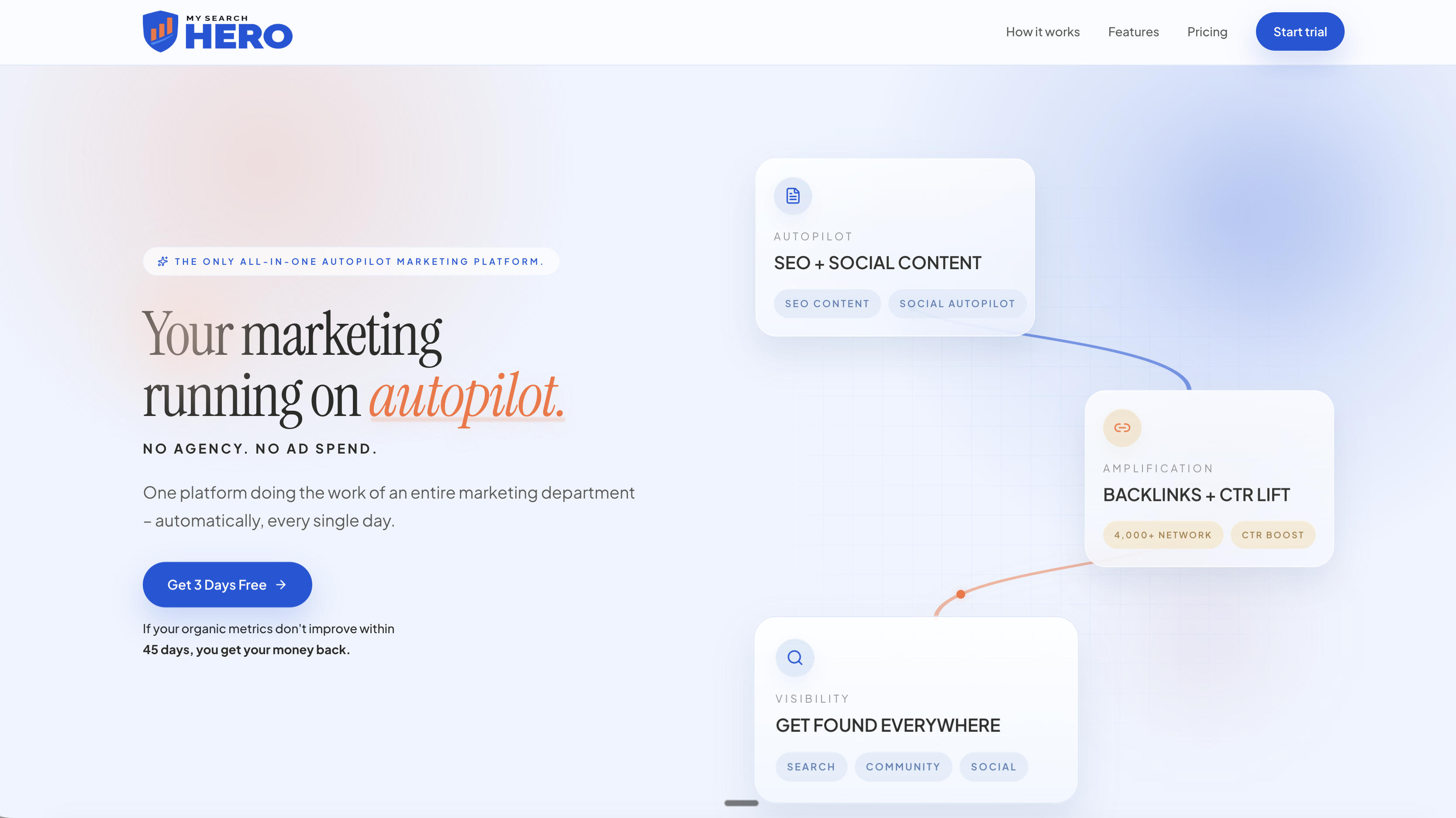
The onboarding process is straightforward: a discovery call to map your business and target keywords, a setup window of a few days, and then monthly deliverables start publishing automatically. You provide your website access and business details. Mysearchhero handles the rest.
Pricing is subscription-based with tiered plans. If you want to see what consistent, automated SEO content does for your local visibility, start with Mysearchhero and get a free audit of your current online presence.
Useful sources
- How Marketing Automation Can Help Your Small Business — EMyth’s guide covers implementation costs, customization, and what owners need to invest before automation pays off.
- 7 Signs Your Home Service Business Needs Marketing Automation — Sovereign AI covers deployment timelines, review volume benchmarks, and AI lead qualification for home service businesses.
- Why Service Businesses Lose Leads — FusionSyncAI breaks down the difference between partial fixes and a full inbound operating system, with leakage reduction benchmarks.
- How to Choose Marketing Automation Software for Small Business — Marathon Insights covers process-first selection and per-contact pricing risk.
- Manual Marketing Tasks That Hurt Small Business Leads — Housipro documents the specific manual tasks that cause lead loss and how centralized capture fixes them.
- Your Business Does Not Have a Marketing Problem — Legacy Growth Blog makes the case for CRM-based journey tracking over spreadsheets.
- What Is Marketing Automation: A Small Business Guide — Mysearchhero’s foundational guide to automation use cases for small businesses.
- How to Automate Marketing for Your SMB in 2026 — Step-by-step tactics and implementation advice relevant to the checklist in this article.
- Automated Outreach Process: A 2026 Guide for Marketers — Covers inbound operating systems, handoff problems, and lead routing in detail.
- Get Found on Google & AI with Service Grower — Complementary local SEO and lead capture resource for service businesses looking to improve Google visibility.
FAQ
What are the best marketing automation tools for small service businesses?
The best fit depends on your bottleneck. For content and SEO, a done-for-you service like Mysearchhero delivers monthly articles, backlinks, and social posts without any configuration work. For lead capture and CRM, look for platforms with native integrations and immediate response automation.
How long does it take to see results from marketing automation?
Lead response improvements show up within the first two weeks. Review volume typically increases within 30–60 days with automated requests. Organic SEO traffic from content automation generally takes 60–180 days to move meaningfully.
What is the biggest risk when choosing marketing automation software?
Per-contact pricing that grows faster than expected is the most common financial trap. Model costs at three times your current contact count before committing. Weak native integrations and vague deliverables are the most common operational risks.
How do I know if I need a managed service or a DIY platform?
If you have a technical team member and a single clearly defined bottleneck under five hours a week, a DIY platform can work. If you want fast local visibility with no configuration overhead, a managed service like Mysearchhero is the lower-risk choice.
How much does marketing automation cost for a local business?
Costs vary widely by platform and scope. DIY platforms often start at a low monthly rate but grow with contact count. Done-for-you services like Mysearchhero use tiered subscription pricing with fixed monthly deliverables, making costs predictable regardless of list size.