
Keyword clusters for local SEO are groups of related search terms organized around one pillar topic and mapped by searcher intent rather than by synonym matching. The single highest-impact first move is to pick your pillar topics and group every related keyword by what the searcher actually wants to do next. We cover how this works in practice on the MySearchHero blog, where we document real cluster builds for local clients.
TL;DR:
- Keyword clusters should be based on actual search intent and SERP behavior rather than synonym matching, ensuring each page targets a specific user goal.
- Building a clear hierarchy with a pillar page and satellite pages, linked internally, enhances topical authority and improves local relevance signals.
- For multi-location businesses, creating one service-based cluster with location-specific satellites is usually more scalable than one cluster per location.
- Regular audits to identify intent conflicts or duplicate pages are essential; consolidating or splitting pages improves ranking stability.
- Incorporating consistent local signals, such as Google Business Profile details and schema markup, reinforces geographic relevance and ranking.
Table of Contents
- What are keyword clusters and topic clusters?
- Why clusters matter for local SEO
- How to build keyword clusters step by step
- Fixing cannibalization and intent dilution
- Adapting clusters for local, multi-location businesses
- How we apply clustering for local clients
- What LLM-driven search means for cluster work ahead
- How we help you build and scale clusters
- FAQ
- Sources
What are keyword clusters and topic clusters?
A keyword cluster is a set of search terms that share the same underlying intent and belong to the same page. A topic cluster is the structure built from those sets, with one pillar page covering a broad subject, surrounded by satellite pages that each answer a narrower question tied to that subject.

Clustering groups terms by intent and SERP behavior, not by synonyms. “Emergency plumber near me” and “24 hour plumbing repair” might look like synonyms, but if Google serves different page types for each, they belong in different clusters.
The structural pieces:
- Pillar page: the broad, authoritative page for the core topic.
- Satellite pages: narrower pages answering specific sub-intents.
- Internal links: a hub-and-spoke pattern connecting satellites back to the pillar.
- Structured data: schema markup that helps search engines parse the relationship between pages.
Why clusters matter for local SEO
Clusters build topical authority by showing search engines (and readers) that a site covers a subject thoroughly rather than publishing one-off pages. That depth tends to improve click-through rates because searchers find pages that match their exact question instead of a generic landing page.
For local businesses, clusters map directly onto Google’s local ranking trio: relevance, distance, and prominence, as described in how local results work. A well-built cluster signals relevance by covering a service and its variations in depth; it supports prominence by earning links and engagement across multiple related pages.
Reviews now shape more than star ratings. Moz’s analysis of reviews and LLMs found that review text and third-party signals increasingly feed AI-generated answers about local businesses, which means review content is becoming part of the same relevance signal that clusters are built to strengthen.
Quick wins from clustering:
- Fewer duplicate or competing pages targeting the same query.
- Clearer internal linking that passes authority to priority pages.
- Content that matches what the SERP actually rewards for that query type.
How to build keyword clusters step by step
Building a cluster system works best as a repeatable process, not a one-time project.
- Audit existing content and intent. List every page and the keyword(s) it currently targets, then check what intent each keyword actually serves in the SERP (informational, transactional, navigational).
- Select pillar topics. Choose the broad subjects that matter most to your business, then identify three to seven meaningful satellite keyword groups per pillar when that range makes sense for the service.
- Cluster by SERP behavior, not synonyms. Group keywords based on the page types Google actually returns for each query, using intent signals over surface-level word similarity, a practice outlined in Moz’s local ranking factors guide.
- Assign keywords to URLs. Every keyword group gets one owning page. When two pages could reasonably serve the same keyword, pick one and redirect or consolidate the other.
- Set internal linking and canonical rules. Link every satellite page to its pillar, and use canonical tags to tell search engines which version of a near-duplicate page should rank.
- Optimize on-page local signals. Add location-specific details, service-area language, and schema markup that reinforces the cluster’s geographic relevance.
- Track cluster performance. Monitor rankings, click-through rate, and conversions at the cluster level, not just per keyword, so you can see whether the pillar and its satellites are moving together.
Pro Tip: Build a simple spreadsheet mapping every keyword to its owning URL before you write a single new page. It catches overlap before it becomes a cannibalization problem.
For teams that want a ready checklist to run alongside this process, our local SEO checklist breaks the same steps into a 12-point sequence.
Fixing cannibalization and intent dilution
Three errors show up repeatedly in cluster audits: synonym-only grouping that ignores actual SERP intent, duplicate service or location pages built for near-identical queries, and conflicting information across Google Business Profile listings that confuses which location should rank for which query.
Diagnosing these doesn’t require guesswork. Watch for ranking oscillation where the same query swaps between two of your own pages week to week, split click data across those pages in search console, and crawler oscillation visible in server logs when bots alternate between near-duplicate URLs.
- Consolidate overlapping pages into one stronger page when intent truly matches.
- Set canonical tags on any page that must stay live for other reasons.
- Strengthen hub links from the pillar to the correct satellite so search engines see a clear hierarchy.
- Split a page into two when it’s trying to serve two distinct intents at once.
Pro Tip: If two pages keep swapping ranks for the same query, that’s usually the clearest sign you need one page, not two.
Adapting clusters for local, multi-location businesses
A single-location business typically needs one cluster per service, with location details woven into the pillar and satellite pages. A multi-location or service-area business needs a decision: build one cluster per location, or one cluster per service with location variants as satellites. The second approach usually scales better once you pass a handful of locations.
Google’s own guidance on service-area and hybrid businesses allows up to 20 service areas by city or postal code per profile, and those settings should align with the geographic scope of your clusters. Google’s guidelines for representing your business also require one profile per physical location, which affects how you structure location-specific pages.
- Match GBP categories to the service terms your pillar pages target.
- Keep citations consistent across directories to reinforce the same entity signals your clusters build.
- Track performance per location, not just per keyword, once you scale past a few service areas.
| Business type | Recommended cluster structure | GBP setup |
|---|---|---|
| Single location | One cluster per service | One profile, fixed address |
| Multi-location | One cluster per service, location satellites | One profile per location |
| Service-area only | One cluster per service, area pages as satellites | Service areas set per Google’s limits |
How we apply clustering for local clients
Our monthly deliverables for local clients are built around clusters from the start rather than published as disconnected articles. Each cycle, we audit existing pages, confirm the pillar topic for that service area, and build satellite content that maps to specific intent gaps we find in the audit.
- We align each satellite page’s local signals with the client’s Google Business Profile categories and service areas.
- We route backlinks and Reddit mentions toward the pillar page to concentrate authority where it matters most.
- We track cluster-level performance across the published bundle, not just individual articles.
Readers who want more detail on the tactics behind this can see worked examples on our local SEO tactics page.
What LLM-driven search means for cluster work ahead
Review text and third-party listings are starting to feed the answers large language models give about local businesses, which means authentic, specific review content carries weight beyond its star rating. That shifts priorities: consistent review collection, accurate GBP details, and content that actually matches what searchers ask for all matter more than keyword density ever did.
The practical move is to treat clusters as living structures. Revisit them when SERP behavior shifts or when review patterns surface new questions customers are asking, rather than treating a cluster as finished once it’s published.
— Mike
How we help you build and scale clusters
Building and maintaining clusters by hand takes consistent, recurring work: audits, new satellite pages, internal linking, and tracking, month after month. We handle that full cycle for local and service-based businesses as part of our monthly plans.
- Published articles organized into pillar-and-satellite clusters, not standalone posts.
- Authority backlinks and Reddit mentions directed to strengthen pillar pages.
- Social posts and CTR signal support tied to the same cluster topics.
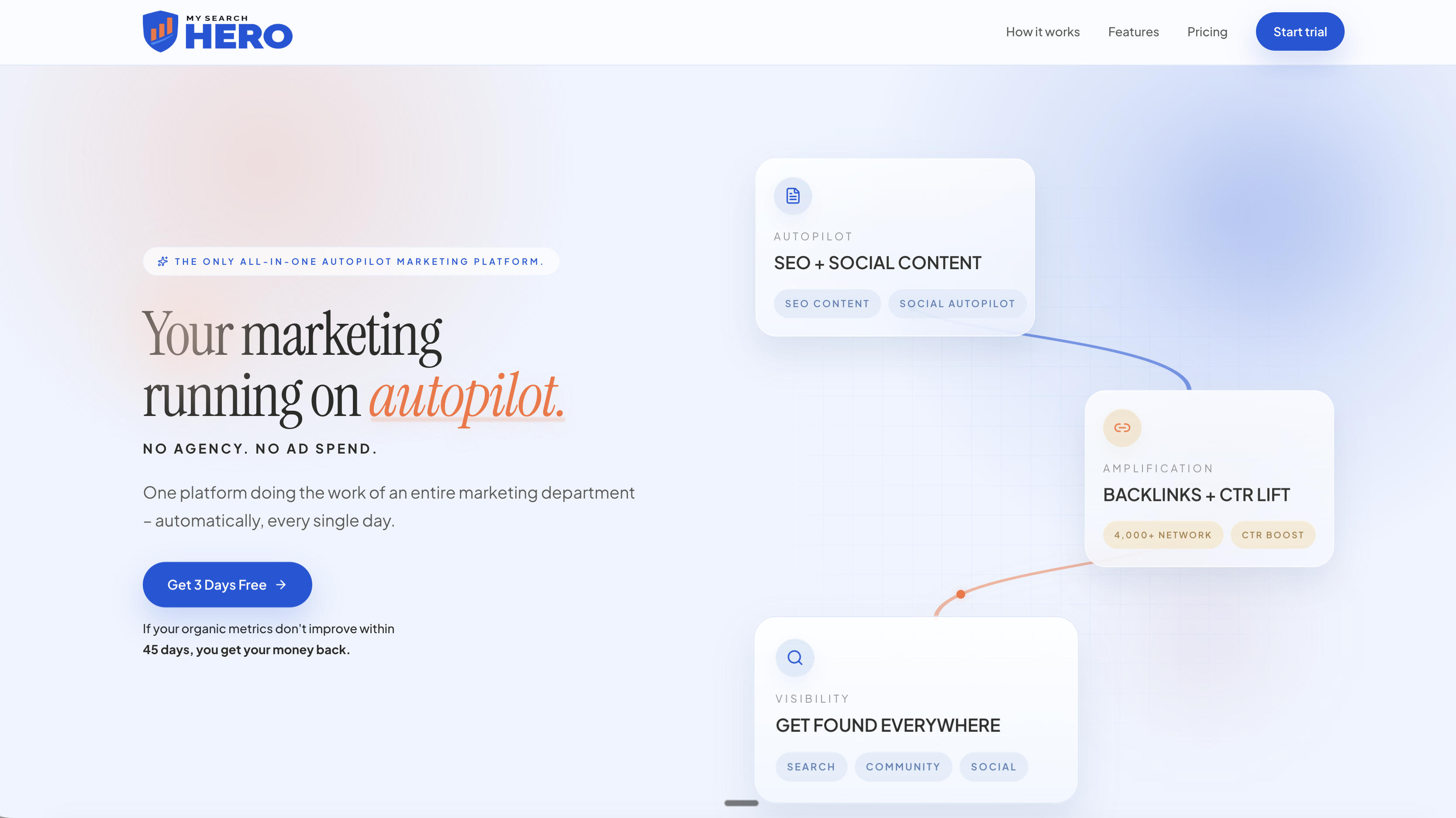
This fits businesses that want cluster-based content without managing the workflow themselves. Plans start at Spark; higher tiers offer additional deliverables per cycle. Check current plan details on our MySearchHero landing page.
FAQ
What is the difference between a keyword cluster and a topic cluster?
A keyword cluster is a group of related search terms sharing the same intent, while a topic cluster is the page structure built around that group, consisting of one pillar page and several satellite pages. The cluster defines which terms belong together; the topic cluster defines how pages are organized to serve them.
How many keywords should go into one cluster?
There is no fixed number, but grouping three to seven meaningful satellite keyword groups under each pillar tends to keep clusters focused without creating bloat. The right count depends on how distinct the search intents actually are for that service.
How do I know if two pages are cannibalizing each other?
Watch for ranking oscillation where the same query alternates between two of your own pages, along with split click data in search console for that query. Server log checks can confirm the issue if crawlers are also oscillating between the two URLs.
Should every local business create one cluster per location?
Not necessarily. A business with a handful of service areas often does better building one cluster per service with location variants as satellite pages, which keeps the structure scalable as you add locations, per Google’s service-area guidance.
Does Google Business Profile data affect keyword clusters?
Yes, GBP categories and service areas should align with the terms your cluster targets, since Google’s guidelines require accurate, consistent profile information per location, and mismatches can confuse which page should rank for which query.