
Brand signals are the entity-level trust cues (mentions, consistency, corroboration across the web) that tell search engines and AI systems whether to treat a brand as a real, credible authority rather than just another website. They now shape whether ChatGPT, Google’s AI Overviews, and traditional rankings cite you at all. The tactics, measurement approach, and common mistakes are below.
TL;DR:
- Branded search volume and descriptive third-party mentions are the most influential signals for AI and search visibility, with mentions correlating strongly to AI overview presence.
- Consistency across business details, schema markup, and reviews significantly reinforces entity recognition, especially on authoritative surfaces like trade press and YouTube.
- Focusing on placement and context of mentions outweighs raw volume, as a single high-quality placement can outperform multiple low-authority mentions.
- Fixing NAP consistency and schema markup in the first 30 days provides quick, low-cost improvements that boost trust signals before pursuing media outreach.
- Measuring progress through branded search growth, mention tracking, referral traffic, reviews, and AI answer presence helps monitor the effectiveness of brand signal building efforts.
Table of Contents
- What Brand Signals Are (And Why They’re Different from Page-Level SEO)
- How Brand Signals Affect Search Engines and AI Systems
- Which Brand Signals Actually Move the Needle?
- How to Strengthen Brand Signals: A 90-Day Playbook
- How Do You Measure Brand Signal Progress?
- Common Myths About Brand Signals
- MySearchHero’s Take on Building Brand Signals
- How Mysearchhero Builds Brand Signals for You
- Sources
- FAQ
What Brand Signals Are (And Why They’re Different from Page-Level SEO)
Brand signals operate at the entity level, not the page level. Where traditional SEO asks “does this page deserve to rank,” brand signals ask “does this business deserve to be recognized as a trustworthy source, period.” Google’s own quality evaluation framework treats brand presence across the document, domain, and entity levels as a distinct set of trust indicators, separate from backlinks or keyword targeting.

Think of it this way: a backlink says “this one page is worth citing.” A brand signal says “this company is a recognized name in its field,” whether or not anyone links to it that day. A plumbing company that gets mentioned by name in a local news story about pipe failures during a cold snap, without a single link, still tells Google and AI models something real about its authority.
The difference shows up in three concrete layers:
- Page-level signals: backlinks, on-page keyword relevance, internal linking
- Entity-level signals: consistent business identity, knowledge graph presence, structured data
- Trust signals: third-party corroboration, review patterns, E-E-A-T markers like clear authorship
How Brand Signals Affect Search Engines and AI Systems
Search engines and AI models both need to answer one question before they cite anyone: is this a real, verifiable entity? Entity recognition depends heavily on consistent, descriptive mentions across the web. When the same brand name keeps showing up next to the same category terms (say, “roofing contractor” or “estate planning attorney”) across independent sources, that repetition helps algorithms resolve who you are and what you do.
E-E-A-T maps directly onto this. Google’s quality guidance treats experience, expertise, authoritativeness, and trust as evaluations that happen at the document, domain, and entity level simultaneously. A brand with scattered, inconsistent information across the web scores worse on that entity-level trust check, even if individual pages are well optimized.
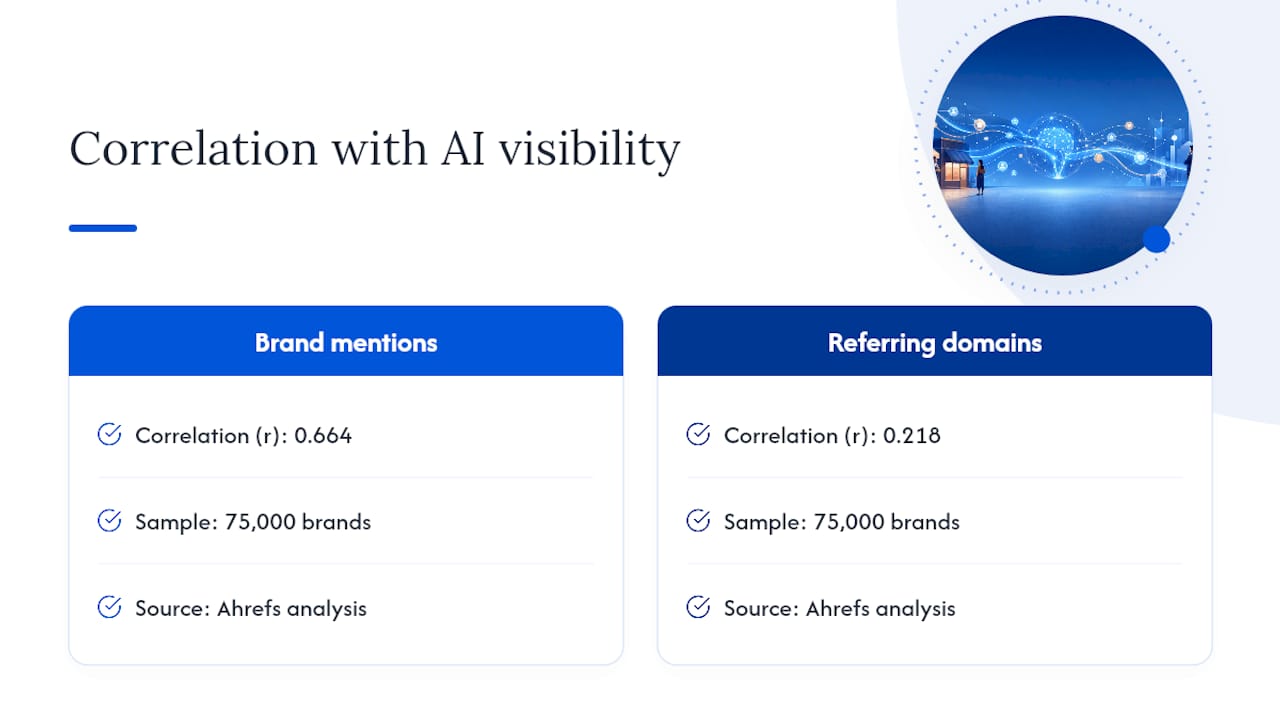
The correlation data backs this up in a way that surprised a lot of SEOs. Ahrefs analyzed 75,000 brands and found web mentions correlated with AI Overview visibility at 0.664, compared to just 0.218 for referring domains. That’s not proof mentions cause visibility. But it’s a strong enough gap that ignoring it would be a mistake.
Which Brand Signals Actually Move the Needle?
Not every mention or metric carries equal weight. Some signals barely register with AI systems; others do most of the heavy lifting. Here’s the priority order that tracks with the current evidence:
- Branded search volume. People typing your business name directly into Google tells search engines you’re a recognized destination, not just a page that ranks for a keyword.
- Third-party descriptive mentions. A mention that sits next to category language (“[Brand] handles emergency HVAC repairs in the metro area”) does far more than a bare name-drop, because proximity to descriptive terms helps AI systems resolve what you actually do.
- High-value surface placement. A mention in trade press, a Wikipedia reference, a LinkedIn feature, or a YouTube video carries more weight than the same words on a low-authority blog.
- Consistency and reputation signals. Matching business details across schema markup,
sameAsproperties, and directory listings, paired with a steady flow of reviews, help resolve your identity and vouch for it. - Community and anchor-text patterns. Reddit threads, forum replies, and podcast mentions add corroboration, especially when the anchor text or surrounding language uses your brand name naturally rather than as a forced keyword.
The pattern across all five: placement and context beat raw volume. A single mention in a trade publication’s comparison table often outperforms fifty scattered forum name-drops.
How to Strengthen Brand Signals: A 90-Day Playbook
Fixing consistency issues costs almost nothing and pays off fast. Chasing earned media and multimedia presence takes longer but compounds. Sequence matters.
- Days 0-30, quick wins. Audit and align your name, address, and phone number across every directory listing. Add or fix schema markup and
sameAslinks pointing to your verified social profiles. Claim any unclaimed business listings. - Days 30-90, earned media push. Pitch trade outlets relevant to your industry with genuinely useful angles, not generic press releases. Write comparison-style content that uses descriptive branded anchor text rather than generic “click here” links, since practitioner data ties trade press and YouTube presence to stronger AI visibility than mass guest posting.
- Day 90 onward, multimedia and community. Publish YouTube content in your niche and get transcripts indexed. Participate authentically in relevant Reddit threads and podcast appearances. Build topical content clusters that demonstrate real breadth, backed by case studies that other sites might cite.
Pro Tip: Before spending a dollar on earned media, fix your NAP consistency and schema first. It’s the cheapest signal to control and the one most AI crawlers check before they trust anything else about you.
How Do You Measure Brand Signal Progress?
Branded search growth in Google Search Console is the single clearest early indicator. If people are typing your business name into search more often month over month, something is working. Pair it with mention tracking tools to count contextual, descriptive mentions (not just raw volume), referral traffic from high-trust domains, and review velocity across platforms.
Useful metrics to track monthly:
- Branded query impressions and clicks (Google Search Console)
- Contextual mention count and sentiment (brand-mention trackers)
- Referral sessions from trade press, YouTube, and forums
- Review volume and average rating trend
- Presence in AI-generated answers for brand-adjacent queries (manual spot checks)
The correlation to watch: Ahrefs found a 0.664 correlation between web mentions and AI Overview visibility, roughly three times stronger than the 0.218 correlation for backlinks. Treat that as directional, not causal, and build your KPIs around trend lines rather than single-month spikes.
Set KPIs as ranges, not hard targets, and always pair a brand-signal metric with a business outcome (leads, calls, bookings) before claiming the tactic worked.
Common Myths About Brand Signals
A few bad assumptions waste real budget. Worth clearing up before you build a plan around them:
- Myth: raw mention count is what matters. It isn’t. Descriptive, proximity-dense mentions on trusted surfaces correlate far more strongly with AI visibility than sheer volume.
- Myth: unlinked mentions are worthless. Many high-value brand mentions carry no link at all, yet they still contribute to entity recognition.
- Pitfall: chasing spammy paid placements. Low-quality sponsored mentions rarely appear in the contexts AI systems weight, and they can dilute trust signals rather than build them.
- Pitfall: treating correlation as proof. No study has shown mentions cause rankings. Design any internal test with a control period and realistic expectations.
MySearchHero’s Take on Building Brand Signals
Most brand-signal advice tells you what to do and leaves you to figure out the execution. Mysearchhero built its service around exactly this gap: bundling published content, earned-style mentions, Reddit presence, and social amplification into one automated pipeline. The workflow is simple to describe even if it takes real coordination to run well: publish contextual content, earn or place a mention where it counts, amplify it across channels, then measure the branded search and referral lift.
That’s the operational version of everything above, running on autopilot instead of a spreadsheet.
— Mike
How Mysearchhero Builds Brand Signals for You
Mysearchhero is the practical way to run this playbook without hiring an agency or managing five separate tools. Instead of piecing together a content calendar, a backlink outreach list, a Reddit strategy, and a social posting schedule yourself, you get all four running every month as one subscription: AI-generated SEO articles published to your site, earned-style backlinks through a publisher network, genuine Reddit mentions in relevant conversations, and AI-generated social posts across platforms.
It’s built specifically for local and service-based business owners who want steady, compounding brand signal growth instead of a one-time SEO push. If you’ve read this far and thought “I don’t have time to run this myself,” that’s exactly the point. Check out Mysearchhero and see which plan matches how fast you want to grow.
Sources
- Decoding Google’s E‑E‑A‑T: A comprehensive guide to quality assessment signals
- Do Brand Mentions Influence AI Visibility? 2026 Data
- Brand mentions vs backlinks: AI citation study (summary of Ahrefs findings)
- Google: Create helpful, people-first content
FAQ
What Is the 3-7-27 Rule in Branding?
There’s no single, widely recognized “3-7-27 rule” in branding backed by credible sources; definitions circulating online vary and aren’t consistent enough to state as established doctrine.
Is SEO Dead Now That AI Answers Questions Directly?
No. SEO has shifted toward entity recognition and brand signals rather than disappearing, since AI Overview visibility still correlates with web mentions and branded search behavior that traditional SEO practices help build.
Is SEO Still Worth Investing in for 2026?
Yes. Branded search volume, entity consistency, and third-party corroboration remain measurable drivers of visibility, and services like branded search tracking make the return easier to prove than ever.
How Do Reddit and Social Mentions Fit into Brand Signals?
Community mentions on platforms like Reddit add corroboration when they appear in genuine, contextual conversation rather than promotional spam, and Mysearchhero includes Reddit brand mentions as part of its monthly deliverables for exactly this reason.