
Your digital presence is the complete set of online touchpoints, systems, and signals that determine whether customers can find you, trust you, and buy from you. That covers everything from your Google Business Profile and website to the CRM tracking repeat customers behind the scenes.
Three things you can do this week to start building it:
- Claim or verify your Google Business Profile at business.google.com so you appear in local map searches
- Audit your website’s contact details — phone number, address, and hours must match everywhere they appear online
- Set one tracking goal in Google Analytics 4 (GA4), such as a form submission or phone-click event, so you have a baseline to measure against
Chamber of Commerce report on technology adoption](https://www.uschamber.com/assets/documents/20251621-CTEC-Empowering-Small-Business-Report-2025-v1-r10-Digital-FINAL.pdf). Small businesses that adopt relevant technology consistently report sales growth and stronger competitive standing. The gap between businesses that manage their digital presence intentionally and those that don’t is widening fast.
Key Takeaways
A strong digital presence requires owning your website and email list, measuring at least one conversion KPI from day one, and building the five layers — Discovery through Retention — in priority order.
| Point | Details |
|---|---|
| Define it precisely | Digital presence includes both public-facing channels and back-end systems like CRM and analytics. |
| Website is the foundation | Consumers treat websites as the authoritative source of business information — social profiles are discovery points only. |
| Measure before you spend | Set a baseline in GA4 and Search Console before running paid ads or changing your site. |
| Follow the 30-day plan | Claim listings, audit your site, install tracking, and ask for reviews in the first 30 days. |
| Mysearchhero automates execution | Mysearchhero delivers monthly SEO articles, backlinks, Reddit mentions, and social posts for local service businesses. |
Table of Contents
- What does a digital presence actually include?
- Why does digital presence matter for your business?
- How do you build and improve your digital presence?
- How do you measure your digital presence?
- Digital presence versus online presence: the five-layer model
- Common mistakes that hurt your digital presence (and fast fixes)
- Your 30–90 day action plan
- What busy owners get wrong about building a digital presence
- Mysearchhero handles the execution so you don’t have to
- Sources
- FAQ
What does a digital presence actually include?
Most people picture a website and a Facebook page. The real picture is bigger, and it splits into two categories: what customers see, and what runs underneath.
Customer-facing channels
- Website: Your owned home base. A well-built site has clear service pages, fast load times, mobile optimization, and a visible call to action on every page. A single generic “Services” page won’t rank locally — separate, optimized landing pages for each service and location (e.g., “HVAC repair in Austin”) are what drive organic traffic.
- SEO and content: Blog posts, service pages, and FAQ content that answer buyer questions before they even reach out. Good SEO means Google can find and surface your pages; good content means visitors stay and convert.
- Social media profiles: Discovery outposts, not your home base. They introduce your brand to new audiences and drive traffic back to your site.
- Listings and reviews: Google Business Profile, Yelp, and industry directories. Reviews move browsers to buyers when they’re actively collected and displayed — a 4.8-star rating with 200 reviews tells a story no ad can replicate.
- Email: The only channel where you own the relationship outright. A list of 500 engaged subscribers is worth more than 5,000 social followers you can’t reach without paying for reach.
- Paid media: Google Ads, Meta Ads, and similar platforms for accelerating discovery when organic reach is slow.
Back-end systems
These don’t show up in a Google search, but they determine whether your front-end channels actually convert:
- E-commerce or booking tools: Shopify, Square, or a simple scheduling widget. If customers can’t complete a transaction without calling you, you’re losing sales.
- CRM: A CRM platform for service businesses tracks leads, follow-ups, and customer history. Even a basic setup in HubSpot or Zoho beats a spreadsheet.
- Analytics and automation: GA4, Search Console, and email automation sequences that nurture leads without manual effort. These are what turn a collection of channels into a system.
Why does digital presence matter for your business?
The short answer: your customers are online, and if you’re not visible there, a competitor is.
A significant portion of U.S. small-business owners still don’t have a website, citing time and lack of knowledge as the main barriers. Businesses that have websites are generally more likely to report higher revenues. Closing that gap presents an opportunity for business owners.
Consumers treat websites as the authoritative record of a business — more than social profiles, more than directory listings. Social channels are where people discover you; your website is where they decide whether to trust you enough to spend money. That distinction shapes everything about how you should allocate your time and budget.
Global daily time spent online remains substantial, which means the window for reaching customers through digital channels is long. A business with no active digital presence is invisible during most of the hours its customers are paying attention.
The business outcomes that improve with a stronger presence:
- More inbound leads from organic search and local listings
- Higher conversion rates when trust signals (reviews, clear CTAs, fast site) are in place
- Lower customer acquisition cost over time as organic channels compound
- Better retention through email and automated follow-up sequences
- Resilience: owned channels (website, email list) don’t disappear when an algorithm changes
How do you build and improve your digital presence?
Think in three tiers: quick wins you can execute this week, medium-term fixes that take 30–60 days, and foundational projects that compound over 6–12 months.
Discovery tactics
- Claim every relevant listing — Google Business Profile, Bing Places, Apple Maps, and any industry-specific directory. Fill every field completely.
- Fix your NAP consistency — Name, Address, and Phone number must be identical across your website, Google Business Profile, and every directory. Discrepancies hurt local map rankings.
- Create one piece of content per buyer question — “How much does [service] cost in [city]?” is a real search. Answer it on a dedicated page.
- Pick one social channel based on where your customers actually spend time. The American Marketing Association recommends matching channel choice to your marketing objective — brand awareness versus direct conversion require different platforms.
Credibility and engagement
- Add trust signals to your homepage: a phone number in the header, a physical address in the footer, real photos (not stock), and a visible review count.
- Start a review-generation process. Ask every satisfied customer by text or email within 24 hours of service. A steady stream of new reviews outperforms a one-time push.
- Publish content that answers buyer questions, not content that promotes your business. Buyers search for answers; they find you in the process.
Conversion fixes
- Audit your CTAs. Every page needs one clear next step: call, book, or get a quote. If a visitor has to hunt for how to contact you, most won’t.
- Check mobile experience. U.S. smartphone usage is high enough that a site that breaks on mobile is effectively broken, period. Test every key page on a real phone.
- Set up conversion tracking in GA4 before running any paid ads. Spending money without knowing what converts is a fast way to waste it.
Retention
- Build an email capture funnel. A lead magnet (checklist, free estimate, discount) converts visitors into subscribers you can market to indefinitely.
- Set up one automated email sequence — a welcome series or post-purchase follow-up — using a tool like Mailchimp or Klaviyo.
- Use remarketing ads to re-engage visitors who didn’t convert on the first visit.
Pro Tip: Batch your content tasks. Write four blog posts in one sitting, schedule them weekly, and you’ve bought yourself a month of consistent publishing without touching it again. Consistency beats frequency.
How do you measure your digital presence?
You can’t improve what you don’t track. Start with one KPI per goal, not a dashboard of 40 metrics you’ll never review.
| Business Objective | Key KPI | Recommended Tool |
|---|---|---|
| Get found in search | Organic impressions, keyword rankings | Google Search Console |
| Drive website traffic | Sessions, traffic by channel | GA4 |
| Generate leads | Form submissions, phone clicks | GA4 (conversion events) |
| Build local visibility | Profile views, direction requests | Google Business Profile Insights |
| Convert visitors | Conversion rate, bounce rate | GA4, Hotjar |
| Retain customers | Email open rate, repeat purchase rate | Mailchimp, your CRM |
A few practical notes on using this:
- Set a baseline first. Install GA4 and Search Console before you change anything. You need a before-and-after to know what’s working.
- Expect a lag. SEO improvements typically take 60–90 days to show measurable movement in rankings. Paid ads and conversion-rate fixes show results faster, often within two weeks.
- Track online presence monitoring as an ongoing habit, not a quarterly audit. A dropped listing or a spike in negative reviews can cost you leads for weeks before you notice.
- SMB website trend data from WordStream shows that conversion-focused site design and lead tracking are among the primary challenges small businesses face — which means getting measurement right is itself a competitive advantage.
Digital presence versus online presence: the five-layer model
The terms get used interchangeably, but they describe different things. Online presence is what’s publicly visible: your website, social profiles, and directory listings. Digital presence is the full ecosystem, including the back-end systems (CRM, automation, analytics, booking tools) that determine whether your visible channels actually perform.
A business can have a strong online presence and a weak digital presence. Lots of followers, no email list. A beautiful website, no conversion tracking. That’s the gap most small businesses live in.
The five-layer model for local businesses maps the full ecosystem:
- Discovery: SEO, local listings, social posts, paid ads. Goal: get found.
- Credibility: Website trust signals, reviews, consistent branding. Goal: earn trust quickly.
- Engagement: Content, social interaction, email nurture. Goal: keep attention.
- Conversion: CTAs, booking flows, landing pages, tracking. Goal: turn visitors into customers.
- Retention: Email sequences, loyalty programs, remarketing. Goal: bring customers back.
Most small businesses overinvest in Discovery and underinvest in Conversion and Retention. They spend on ads to drive traffic to a site that has no clear CTA and no follow-up system. The result is expensive traffic that doesn’t convert.
Who manages each layer matters too. Discovery often falls to an SEO or marketing generalist. Credibility is partly a design and ops problem (keeping listings accurate, responding to reviews). Conversion is where a web developer or CRO specialist earns their keep. Retention is owned by whoever manages your email platform or CRM.
Pro Tip: Your website is the only asset in this entire ecosystem you fully control. Social platforms change their algorithms; directories can suspend listings; ad platforms can ban accounts. Treat your website and email list as the foundation everything else feeds into.
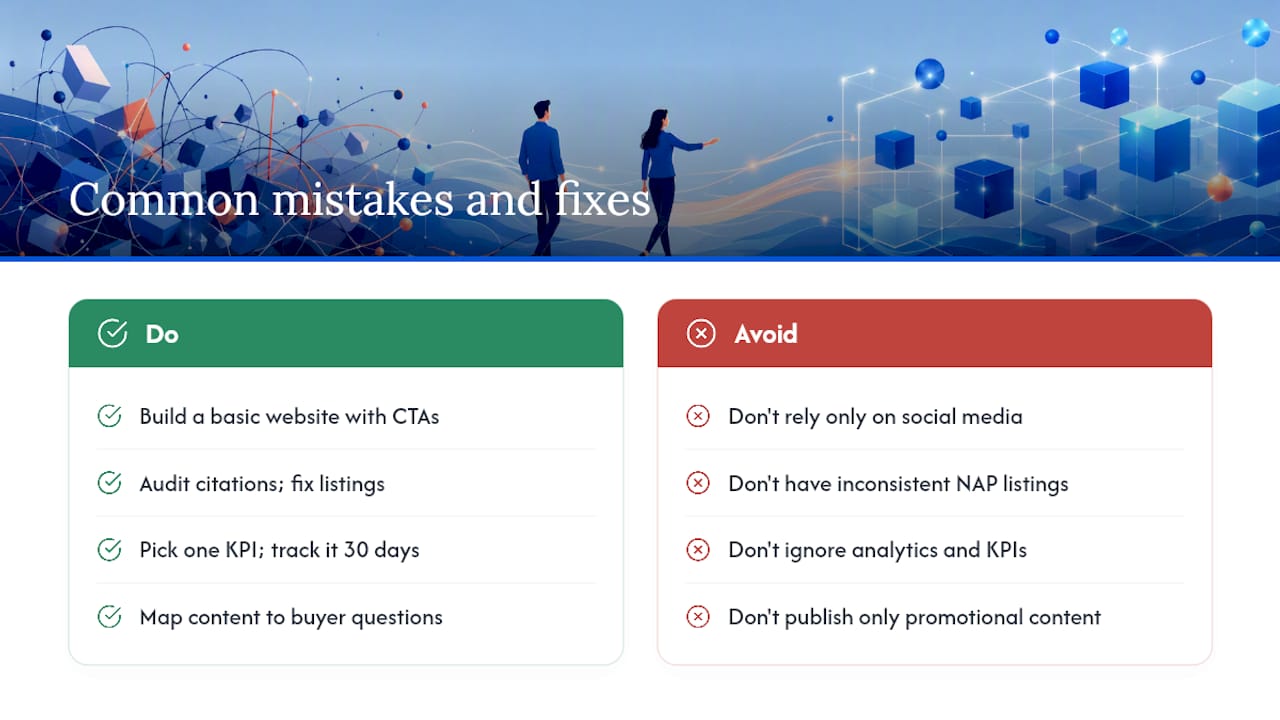
Common mistakes that hurt your digital presence (and fast fixes)
Relying only on social media with no owned site. Social profiles are rented space. When the algorithm shifts or the platform declines, your audience disappears with it. Fix: build a basic, conversion-ready website first, even a five-page site with clear CTAs.
Inconsistent NAP across listings. If your address is listed differently on Google, Yelp, and your website, search engines treat them as different businesses. Fix: run a citation audit using a tool like BrightLocal or Moz Local, then correct every discrepancy.
Ignoring measurement entirely. If you don’t know your baseline traffic, conversion rate, or lead volume, you can’t tell whether anything you’re doing is working. Fix: pick one KPI, set a baseline this week, and track it for 30 days before changing anything else.
Publishing content that’s all promotion, no utility. “We’re the best plumber in Denver” is not content. “How to tell if your water heater needs replacing” is. Fix: map every piece of content to a specific buyer question at a specific stage of the decision process.
Overcomplicating automation before the basics are in place. Buying a $500/month marketing automation platform before you have a working email list or a tracked conversion event is backwards. Fix: start with a simple CRM (HubSpot free tier or Zoho) and one automated sequence, then layer complexity as you grow. Automating your marketing works best when the underlying system is already producing results manually.
Your 30–90 day action plan
Days 1–30: foundations
- Claim and fully complete your Google Business Profile, Bing Places, and Apple Maps listings.
- Audit your website: check that contact details are correct, pages load in under 3 seconds on mobile, and every page has a visible CTA.
- Install GA4 and Google Search Console. Set up at least one conversion event.
- Pick one paid channel (Google Ads or Meta Ads) and run a small test campaign — $10–$20/day — to learn what messaging converts before scaling.
- Ask your last 10 customers for a Google review.
Days 31–60: build and capture
- Publish optimized service or location pages for your top two or three offerings. Each page targets a specific service-plus-city keyword.
- Launch a basic email capture: a lead magnet on your homepage connected to an email platform.
- Start a systematic review-generation process — automate the ask via text or email after every completed job.
- Publish two to four pieces of content that answer real buyer questions in your niche.
Days 61–90: convert and retain
- Launch a small remarketing campaign targeting website visitors who didn’t convert.
- Connect your website’s lead forms to your CRM so every inquiry is tracked automatically.
- Set up a three-email welcome sequence for new subscribers.
- Review your GA4 data: which pages convert, which don’t, and what’s driving the most qualified traffic?
Budgeting note: For most local service businesses, the highest-ROI sequence is: website and tracking first, then local SEO and listings, then a small paid-ads test, then content and email. Paid ads without a converting website is money out the window. A digital marketing strategy guide can help you map budget to channel priority as you scale.
What busy owners get wrong about building a digital presence
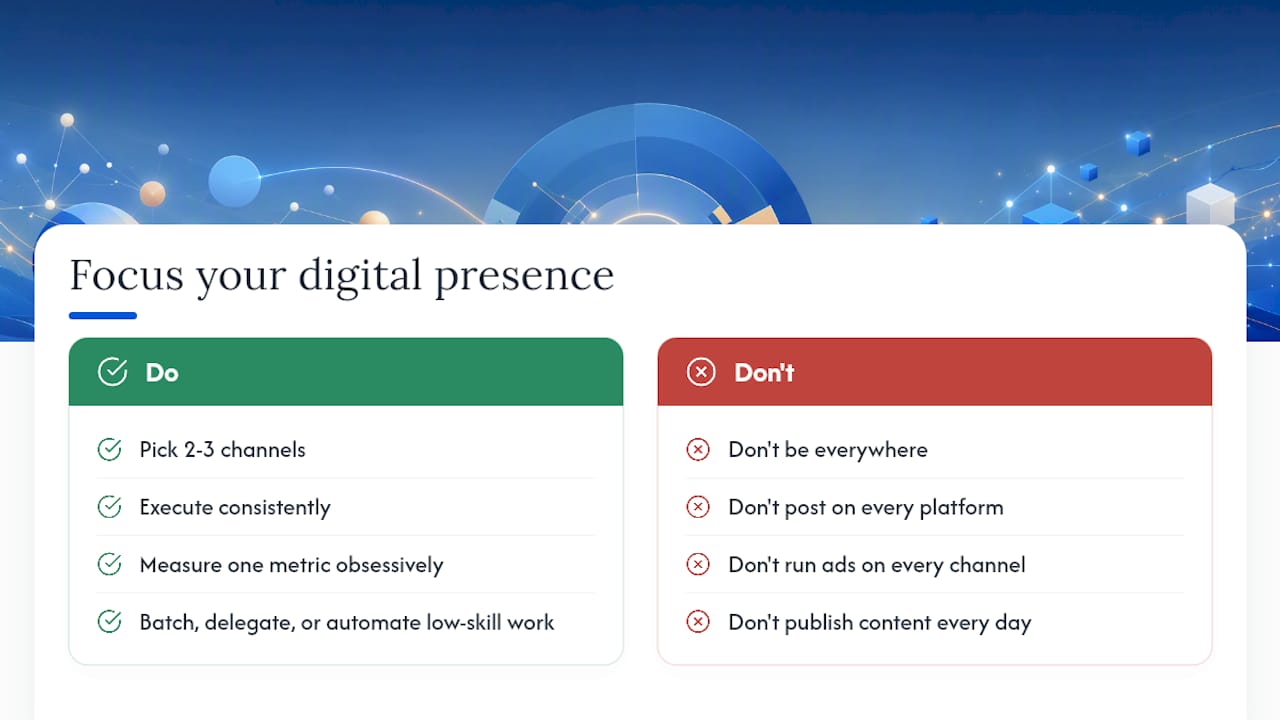
The conventional wisdom says “be everywhere.” Post on every platform, run ads on every channel, publish content every day. For a solo operator or a small team, that advice is a recipe for burning out and doing everything poorly.
The businesses that build durable digital presence do the opposite. They pick two or three channels, execute them consistently, and measure obsessively. A plumber with a well-optimized Google Business Profile, 80 five-star reviews, and a website that loads in two seconds will outperform a competitor with six social accounts and no tracking.
The other thing owners underestimate: the compounding effect. SEO, email lists, and review counts all grow over time. The business that starts today will have a six-month head start on the one that waits until conditions are “perfect.” Batch your tasks, delegate or automate the low-skill work, and measure one thing at a time. That’s the whole playbook.
Mysearchhero handles the execution so you don’t have to
Building a digital presence manually — writing SEO articles, earning backlinks, staying active on social, managing Reddit mentions — takes more hours per week than most business owners have.
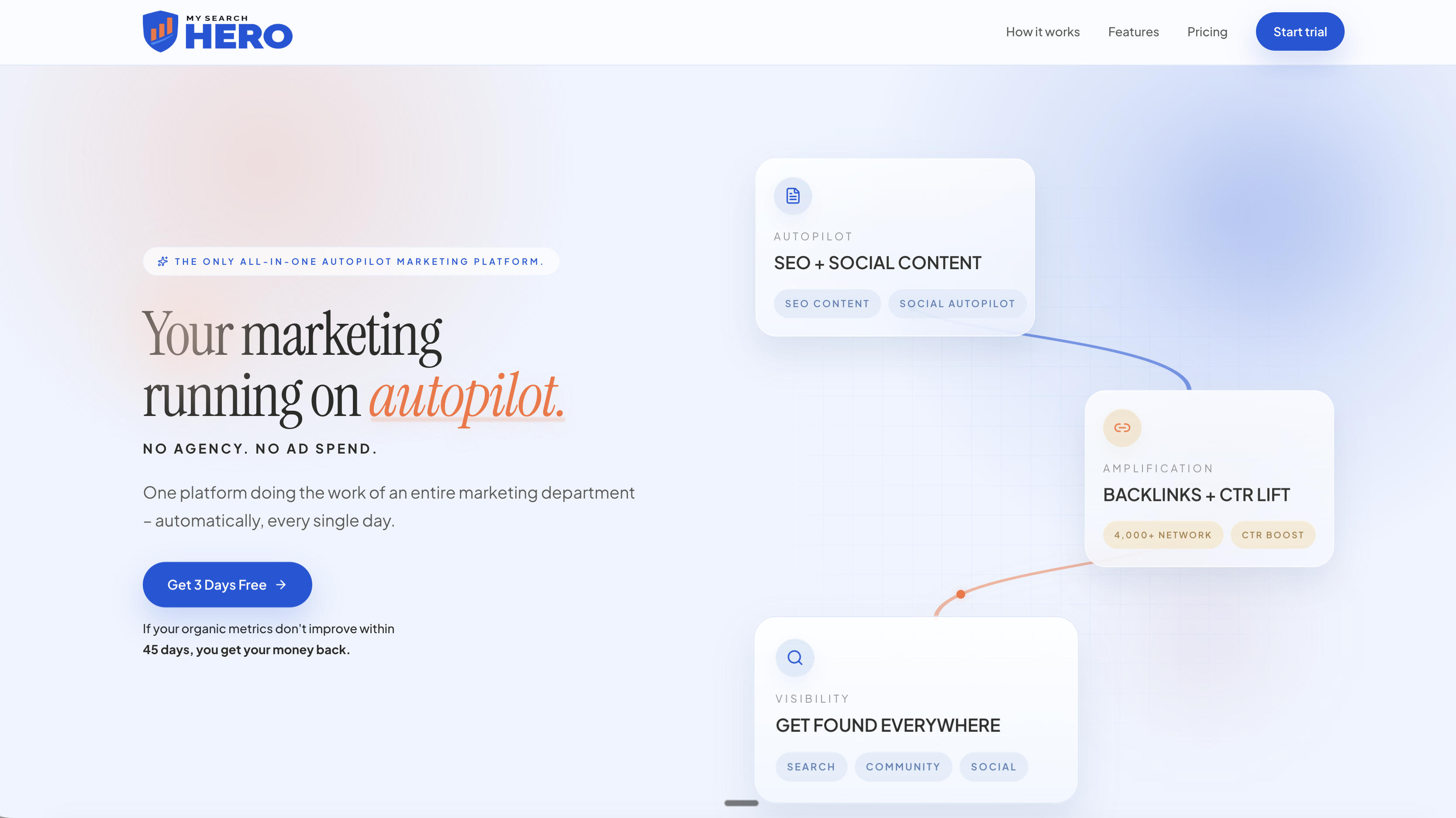
Mysearchhero is a done-for-you SEO and content marketing service built specifically for local and service-based businesses. Every month, subscribers receive a bundle of published SEO articles pushed directly to their website, authority backlinks through a vetted publisher network, Reddit brand mentions in relevant conversations, and AI-generated social media posts across multiple platforms — all through a fully automated pipeline.
- Publish velocity: consistent content output without writing a word yourself
- Citation and backlink building: authority signals that compound over time
- Social amplification: platform presence maintained without daily manual effort
If you’ve read this guide and know what needs to happen but don’t have the bandwidth to execute it, Mysearchhero is the managed alternative. Start a free trial and see what a month of automated SEO output looks like for your business.
Sources
- Small businesses face obstacles and opportunities growing online presence
- 2026 Local Business Trust Index: Websites Win – DreamHost
- Statista
FAQ
What is digital presence in simple terms?
Digital presence is everything that represents your business online — your website, social profiles, listings, reviews, and the back-end systems that connect them. It determines whether customers can find you, trust you, and complete a transaction.
How is digital presence different from online presence?
Online presence refers to what’s publicly visible (website, social pages, directory listings). Digital presence includes those plus the behind-the-scenes systems — CRM, analytics, booking tools, and automation — that make the visible channels perform.
How long does it take to build a strong digital presence?
Conversion-rate fixes and listing optimizations can show results within two to four weeks. SEO improvements typically take 60–90 days to move rankings measurably. Email and content compound over six to twelve months.
What is the single most important part of a digital presence?
Your website. Consumers treat it as the authoritative record of your business, and it’s the only asset you fully control — social platforms and directories can change their rules or suspend your account at any time.
Can Mysearchhero help build my digital presence?
Yes. Mysearchhero delivers monthly SEO articles, authority backlinks, Reddit mentions, and social media posts for local and service-based businesses through a fully automated pipeline, covering the Discovery and Credibility layers without requiring manual effort from the business owner.