
Service page SEO means structuring and writing an individual service page so search engines can index it correctly and buyers convert once they arrive. The single highest-impact move is aligning the page’s content to high-intent buyer queries and the conversion flow, while keeping the mobile version equal to desktop. Below, we walk through a working checklist, the technical targets that matter in 2026, and how to measure progress.
TL;DR:
- Choose one primary commercial keyword and two to four close variants, placing them in relevant headings rather than repeating the main phrase throughout.
- Keep mobile content aligned with desktop and make accordion details crawlable; target LCP within 2.5 seconds, INP under 200 milliseconds, and CLS below 0.1.
- Give each service or location page unique copy; near identical city pages can compete against one another, while canonical tags belong on true duplicates.
- Place a clear primary call to action above the fold and after scope details, supported by verifiable reviews, case results, or client logos.
- Review search visibility, conversions, and Core Web Vitals monthly; refresh content quarterly, and test one call to action change at a time.
Table of Contents
- The anatomy of a high-performing service page
- How to write service-page copy that ranks
- The technical and mobile requirements behind rankings
- On-page mechanics: metadata, URLs, and schema
- Conversion and trust signals that support both buyers and rankings
- Internal linking and where service pages fit in your site
- Measuring and maintaining service page performance
- A practical checklist and what backs it
- When to DIY and when to bring in help
- How we help you execute this without adding headcount
- FAQ
- Sources
The anatomy of a high-performing service page
A service page earns rankings and revenue when its structure answers two questions at once: what does a search engine need to understand the page, and what does a buyer need to say yes. Those needs overlap more than most site owners assume.
Start with a hero section that states what the service is, who it serves, and a single clear next step. A page that buries the offer under a slogan loses visitors before they scroll. Below the fold, lay out the scope of work: deliverables, rough timeline, and what’s included versus what costs extra. Buyers abandon pages that force them to call just to find out the basics.
Pricing doesn’t need an exact number, but giving a shape (a starting price, a typical range, or “custom quotes based on square footage”) reduces bounce from price-shoppers who were never going to convert anyway. Visuals matter too: a hero image, a simple process graphic showing your steps, and two or three portfolio shots build context faster than paragraphs of description.
A well-built page usually includes:
- A hero headline with a clear unique value proposition and one primary call to action
- A short above-the-fold summary answering what you do, who it’s for, and what to do next
- A scope section listing deliverables, timeline, and inclusions or exclusions
- A pricing cue, even an approximate range, rather than silence
- Supporting visuals: hero image, process graphic, small portfolio samples
- A scannable body with short sections and a brief FAQ near the bottom
Each block does double duty. The headline and summary give search engines the page’s topic in the first hundred words, while the scope section and FAQ capture the long-tail questions buyers type into Google before they’re ready to call.
How to write service-page copy that ranks
Keyword selection for a service page works best when it stays narrow. Pick one primary commercial keyword, the phrase a buyer would type when ready to hire, and pair it with two to four close variants that cover how different people phrase the same need. Map each variant to a heading rather than repeating the primary phrase everywhere.
Write to the questions a buyer actually has: do you handle situations like mine, what’s the process, how long will it take, what does it cost, what happens if something goes wrong, and what’s the next step. Google’s own guidance on helpful, people-first content recommends answering genuine user needs and placing keywords naturally in prominent spots rather than stuffing them for algorithms.
Practical placement matters more than density:
- Primary keyword in the title tag, the H1, and the first 100 words of body copy
- Variant keywords in H2 or H3 subheadings where they match the question being answered
- Descriptive alt text on images that mentions the service, not just “photo1”
- A short FAQ block at the bottom to catch related searches and featured-snippet opportunities
- Unique copy on every service and location variant to avoid duplicate content, using canonical tags where true duplicates exist
That last point trips up a lot of service businesses with multiple locations or service-area pages. If you run near-identical copy across five city pages, you’re competing with yourself. A service area page needs its own angle, not a find-and-replace on the city name.
The technical and mobile requirements behind rankings
Content can be excellent and still underperform if the page loads slowly or renders differently on a phone than on a desktop. Google indexes the mobile version of your site by default under mobile-first indexing, so the mobile page’s primary content, headings, titles, and structured data need to match desktop, not summarize it.
Google recommends Core Web Vitals targets of LCP within 2.5 seconds, INP under 200 milliseconds, and CLS under 0.1 for a good page experience. Those three metrics measure loading speed, how quickly the page responds to taps or clicks, and whether elements jump around as it loads, all of which affect whether a visitor sticks around long enough to read your offer.
A common and costly mistake: hiding scope details, pricing, or FAQ answers behind accordions that only load on interaction. If Google’s crawler can’t access that content the way a mobile user would, it may never get indexed, even though it’s technically on the page.
Quick wins most marketers can request without a developer:
- Compress hero and portfolio images, and use modern formats like WebP or AVIF
- Preconnect to critical third-party hosts such as booking widgets or chat tools
- Defer noncritical JavaScript so it loads after the main content
- Test accordions with a crawler simulator to confirm the content is actually indexable
Escalate to a developer when the fix involves server response time, render-blocking CSS in the page head, or heavy third-party scripts that can’t be deferred without breaking functionality. Our own notes on mobile SEO cover more of these fixes in depth.
On-page mechanics: metadata, URLs, and schema
Metadata is the part of service page SEO most businesses get half right. A title tag works best as primary keyword, a short differentiator, then your brand name, kept under roughly 60 characters so it doesn’t get truncated in results. A meta description should lead with the buyer benefit and close with a soft call to action, under about 160 characters.
URL structure should stay short and keyword-aware: a URL like /kitchen-remodeling beats one with session parameters or a publish date baked in, since dates can make a page look stale even when the content isn’t.
Structured data gives search engines explicit signals instead of inference:
- Add Service schema with fields for service type, provider, and area served
- Add FAQ schema to any genuine Q&A block, matching the visible questions exactly
- Use breadcrumb markup so search results show your site hierarchy
- Set a self-referencing canonical tag on every service page to prevent duplicate indexation from tracking parameters
None of this requires custom development on most modern website platforms, just careful field-by-field entry.
Conversion and trust signals that support both buyers and rankings
A page can rank and still fail to convert if it gives visitors no reason to trust the business behind it. Trust signals also tend to improve the engagement metrics (time on page, lower bounce) that make a page more competitive.
Primary CTAs (“Get a Free Quote,” “Book a Consultation”) belong above the fold and again after the scope section. Secondary CTAs (“See Our Work,” “Read FAQs”) give hesitant visitors a lower-commitment next step instead of losing them entirely.
Social proof works best in small, specific doses:
- Star ratings or review counts near the top of the page
- A short case snippet: one headline, one or two lines of result, a link to the full case page
- Client logos if you serve recognizable businesses
- Quantified outcomes stated plainly, without rounding up or guessing
Review schema should only mark up reviews you can actually verify came from real customers; marking up fabricated or unverifiable ratings risks a manual action, not just a bad look.
Pro Tip: Rotate your above-the-fold testimonial seasonally so returning visitors and search crawlers both see fresh proof rather than the same quote for three years straight.
Internal linking and where service pages fit in your site
A service page performs better when it sits inside a logical structure rather than floating as an orphan page. Group all service pages under a visible “Services” hub, and link to each from relevant blog posts that discuss related problems; our piece on why SEO matters for service businesses is one example of a supporting post that can funnel authority back to a service page.

Anchor text should describe what’s on the other end (“our kitchen remodeling process”) rather than repeating the exact keyword phrase in every link, which reads as spam to both users and algorithms.
A few structural habits worth building:
- Link each service page to your contact page, pricing information, and a relevant portfolio or case study
- Use supporting blog content to build topical depth around the service, feeding authority back to the money page
- Reserve noindex for very narrow service variants that don’t have enough unique content to stand alone
- Review your site’s hierarchy quarterly to catch orphaned or duplicate pages
Get this right and your service pages stop competing with each other for the same rankings.
Measuring and maintaining service page performance
SEO work on a service page doesn’t end at publish. Page experience signals support conversion by removing friction, but they don’t guarantee rankings on their own, so measurement has to cover both visibility and behavior.
- Track keyword rankings, impressions, clicks, and click-through rate in Search Console weekly or monthly.
- Watch conversion rate and Core Web Vitals scores alongside traffic, since a traffic increase that doesn’t convert points to a messaging or trust problem, not a technical one.
- Run monthly checks for Search Console errors or sudden performance drops, and schedule a quarterly content refresh to update pricing cues, FAQs, and proof points.
- Test one CTA change at a time (button text, color, or placement) and let it run long enough to gather a meaningful sample before drawing conclusions.
- Request reindexing through Search Console after any substantive content rewrite rather than waiting for the next natural crawl.
A realistic cadence looks like light monthly checks and a heavier quarterly pass, with a full technical and conversion audit once a year or after a major service change.
A practical checklist and what backs it
Pulling the sections above into one working list makes this easier to execute on a Monday morning:
- Headline states the service, audience, and one clear benefit
- Title tag and meta description follow the formulas above and stay under length
- Mobile version matches desktop content, headings, and structured data
- Core Web Vitals meet target thresholds on a real mobile test, not just desktop
- Service and FAQ schema are added and validated
- Primary CTA appears above the fold and after the scope section
- At least one verifiable trust signal (review, case snippet, or client logo) is visible
- A measurement plan is in place before the page goes live, not after
We built this checklist running the same process across client service pages every month, which is also where our own operational notes and client outcomes come from. For businesses deciding whether to execute this in-house, our guide on sourcing a content writer is a useful next read before hiring.
When to DIY and when to bring in help
Minor fixes, a rewritten headline, a compressed image, a new FAQ entry, are worth doing in-house with almost no learning curve. Meaningful lift usually takes a few months of consistent publishing and technical cleanup, not a single afternoon.
Hire a developer when the fix touches server response time or render-blocking code. Consider an automated service when the bottleneck isn’t knowledge but hours: someone still has to write, publish, and monitor every month.
— Mike
How we help you execute this without adding headcount
Everything in this checklist is work that has to happen every month, not once. Through MySearchHero, we handle the recurring half of service page SEO: published articles that build topical depth around your services, backlinks from our publisher network, Reddit mentions that put your brand into relevant conversations, and AI-generated social posts that keep your profiles active, all with CTR signal boosting layered on top.
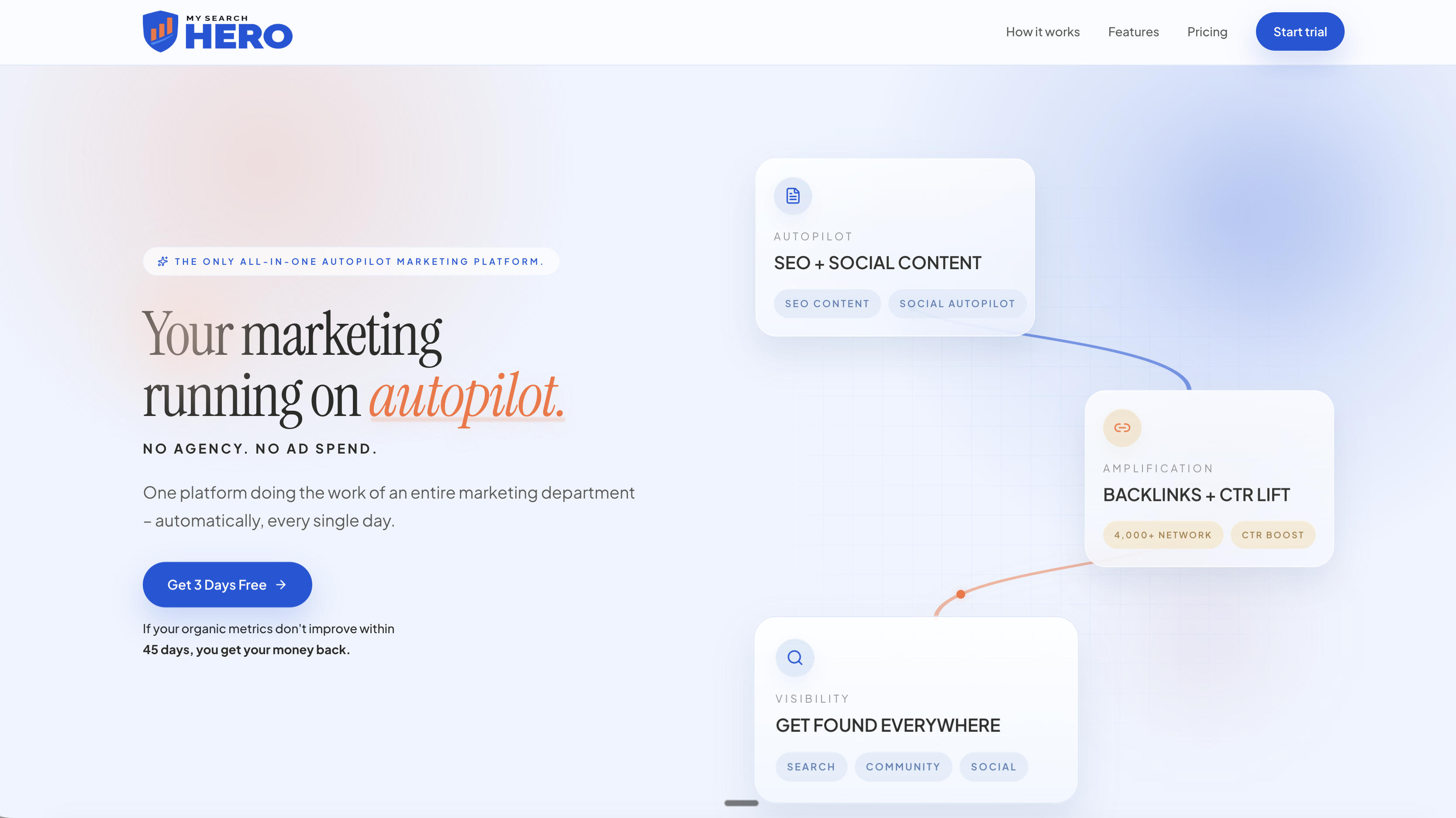
We run this as a monthly subscription so the work keeps compounding instead of stalling after a one-time audit. Plans start at Spark and scale up through Authority, Hero, and Enterprise depending on how much output you need, backed by a 45-day money-back guarantee if your organic metrics don’t move. If you’d rather hand the recurring work to us while you focus on the business, see the current plans and pick the one that matches your workload.
FAQ
What are service pages in SEO?
Service pages are individual pages on a website dedicated to one specific offering, like “roof repair” or “bookkeeping for small businesses,” built to rank for buyer searches around that service. They differ from blog posts because their job is conversion first, with ranking as the mechanism that gets buyers there.
How do I rank a service page?
Ranking a service page starts with matching its content to high-intent buyer queries, writing clear answers to fit, process, timeline, and price questions, and making sure the mobile version contains the same primary content as desktop under mobile-first indexing. Pair that with solid Core Web Vitals scores and a few verifiable trust signals to support both visibility and conversion.
What are the 4 types of SEO?
SEO is commonly broken into on-page SEO (content and metadata on the page itself), technical SEO (site speed, crawlability, structured data), off-page SEO (backlinks and mentions elsewhere), and local SEO (visibility in location-based searches). A service page typically needs attention from all four, though the mix depends on whether the business serves a local area or a wider market.
What is the 80 20 rule for SEO?
In SEO, a small share of your pages, keywords, or fixes usually drive most of your traffic and conversions, so prioritizing the highest-intent service pages and the technical fixes with the broadest impact (like Core Web Vitals) tends to outperform spreading effort evenly across every page. In practice, that often means fixing your top three service pages thoroughly before touching the rest of the site.